You know how you can feel it the moment you walk into a company that just works? Decisions get made fast. Teams talk to each other. Goals are crystal clear from the CEO to the newest hire. That feeling has a name: organizational effectiveness.
At its core, it is a company’s ability to align strategy, people, processes, and resources to produce consistent, measurable outcomes. It is not about being busy. It is not about hiring more people or buying more software. It is about building a machine that converts goals into results, reliably and efficiently.
Most leaders think performance problems are talent problems. They are usually system problems. An under-resourced team with clear goals, strong processes, and aligned leadership will outperform a star-studded roster running on unclear priorities and siloed communication every single time. The data backs this up, and we will get to the numbers in a moment.
Understanding effectiveness at an organization means looking at your whole organization as a connected system. Change one part without considering the others, and you create friction, not progress.
The Organizational Effectiveness Crisis in 2026
Here is the uncomfortable truth. Most organizations are not operating effectively. And the numbers are getting worse.
According to Gallup’s Global Workplace report, global employee engagement fell to 20% in 2025, down from a peak of 23% in 2022. That is three consecutive percentage points lost in three years, the first time Gallup has ever recorded two straight years of decline. No region of the world saw engagement increase.
In the US, the picture is even bleaker. Only 31% of American workers report being engaged. The ratio of engaged to actively disengaged employees in the US dropped to 1.8-to-1 in 2026, down from 2.1-to-1 in 2025. That narrowing gap is a red alert for business performance.
| Metric | 2022 | 2025/2026 | Change |
| Global employee engagement | 23% | 20% | -3 pts |
| US employee engagement | ~33% | 31% (11-yr low) | Declining |
| Actively disengaged globally | ~15% | 17% | +2 pts |
| Annual global productivity loss | ~$7.8T | $8.8T | +$1T |
| US engaged-to-disengaged ratio | 2.1:1 | 1.8:1 | Narrowing |
The flip side is equally powerful. A Gallup meta-analysis consistently shows that highly engaged workforces deliver 23% greater profitability, 14% higher productivity, 18% more sales, and 81% lower absenteeism.
Are You Using the Right Organizational Effectiveness Model for Your Business?
Not all frameworks fit every company. The model you choose should reflect your goals, industry, and culture. Here are the five most widely used models, and when to reach for each one.
1. The Goal Attainment Model
The most straightforward approach: measure effectiveness by how well you hit your stated targets. Set clear goals, define success metrics, and track results. This model works best for companies with well-defined, measurable outputs like manufacturing, sales, or logistics operations. The catch is that it only functions if your goals are the right ones.
2. The McKinsey 7-S Framework
Developed by Peters and Waterman at McKinsey in the late 1970s, the 7-S model maps seven interdependent elements: Strategy, Structure, Systems, Skills, Staff, Style, and Shared Values. The core premise is that performance improves when these seven elements reinforce each other. Mismatches create friction and lost value. This remains the most comprehensive diagnostic tool for organizations navigating major change or transformation.
3. The Systems Resource Model
This model asks whether your organization is acquiring and using resources efficiently enough to sustain performance. It is particularly relevant for nonprofits, government bodies, or companies in resource-constrained environments where efficiency and sustainability matter as much as output.
4. The Competing Values Framework
Organizations face real tensions: stability versus innovation, control versus flexibility, short-term results versus employee well-being. The competing values model, developed by Quinn and Rohrbaugh, says effectiveness comes from balancing these forces intelligently rather than picking one dimension and ignoring the rest.
5. The Stakeholder Model
This newer approach measures effectiveness by whether you are meeting the genuine needs of all stakeholders: customers, employees, investors, and regulators. In 2026, with social media amplifying every employee and customer voice, organizations that ignore this model do so at serious reputational risk.
READ MORE:
- Organizational Design and Development: A Comprehensive Guide
- How Organizational Structure in Business Controls Growth, Speed, and Culture
How to Measure Organizational Effectiveness: The Metrics That Actually Matter
You cannot manage what you cannot measure. Here is a practical framework for tracking organizational health across four dimensions.
| Dimension | Key Metrics | Why It Matters |
| Financial Health | Revenue growth, profit margin, ROI, cost per unit | Validates that effectiveness translates to business value |
| Operational Efficiency | Cycle time, process throughput, resource utilization | Reveals where your system leaks capacity |
| People Performance | Engagement scores, turnover rate, and absenteeism | Predicts future performance before it shows in financials |
| Customer Impact | NPS score, retention rate, satisfaction index | Confirms you are creating external value, not just internal noise |
| Innovation Capacity | New products launched, AI adoption rate, R&D spend | Measures adaptability and long-term competitiveness |
One critical insight from Deloitte’s research: KPIs should not exist in isolation. Build an interconnected measurement framework where improvement in one area does not come at the expense of another. Leaders who connect their KPIs to strategic objectives report being 20% more likely to attribute significant enterprise value to their improvement programs.
A digital dashboard that integrates your HRIS and ERP data gives every leader real-time visibility into what matters. Decisions made with live data move faster and land better than those made in quarterly review cycles.
7 Strategies to Boost Organizational Effectiveness Starting Today
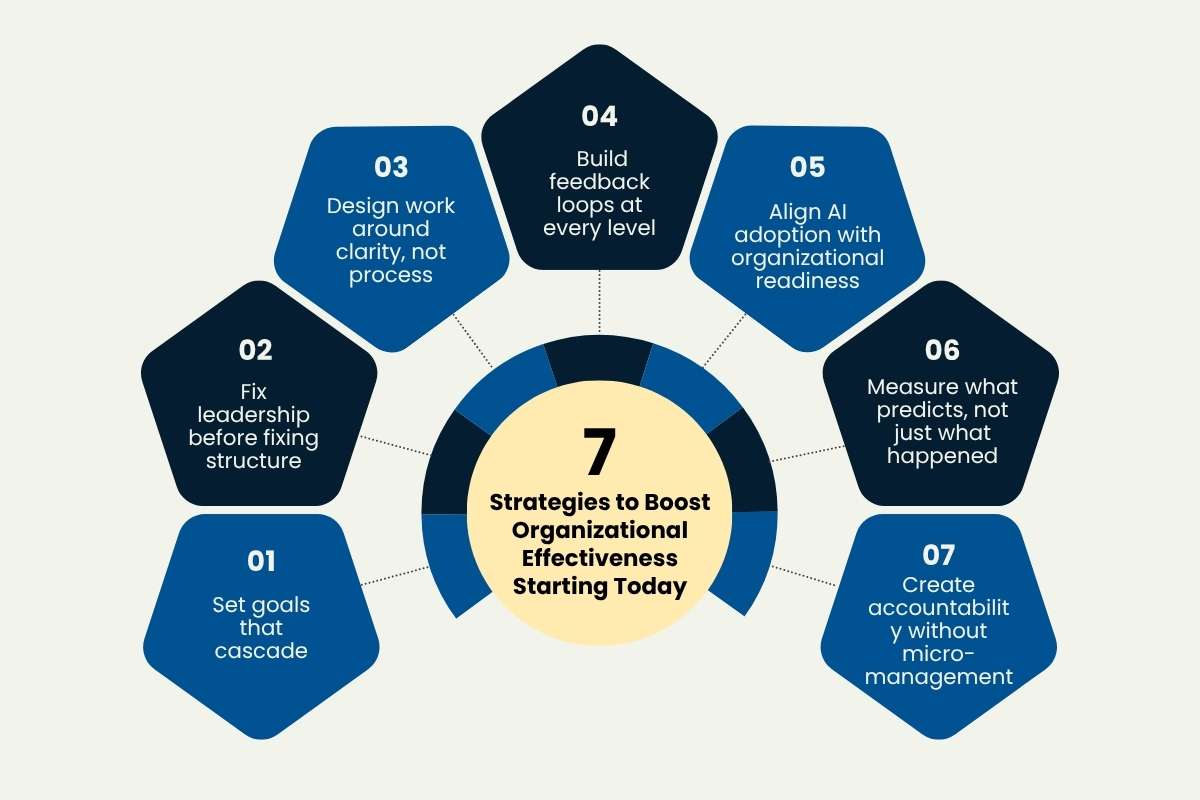
These are not theoretical frameworks. They are actions you can implement in the next 90 days.
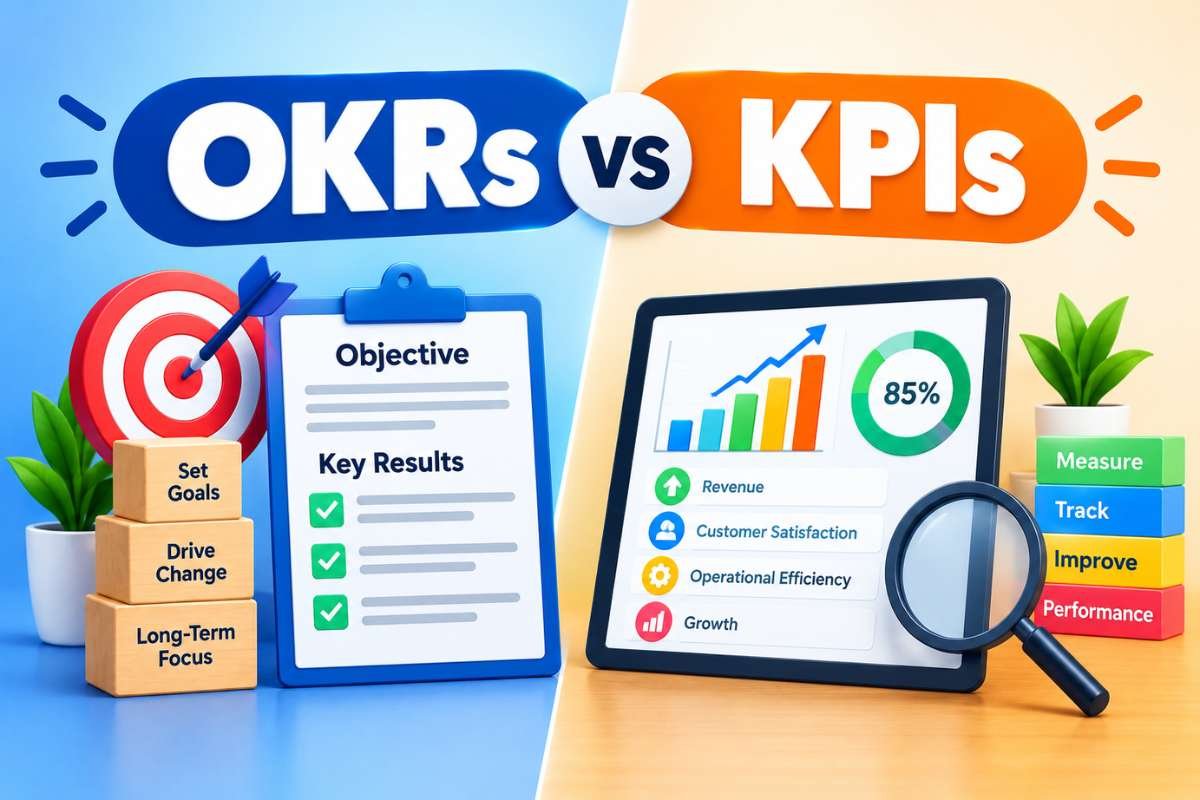
- Set goals that cascade. Every team’s goals should trace directly back to the company strategy. If a team cannot explain how their work moves a strategic needle, their goals need rewriting. Tools like OKRs (Objectives and Key Results) make this visible across all layers.
- Fix leadership before fixing structure. Effectiveness starts at the top. McKinsey’s data shows that manager engagement dropped nine points since 2022, the biggest drag on team performance globally. Invest in leadership development before you reorganize reporting lines.
- Design work around clarity, not process. Clear roles, clear decisions, clear priorities. Ambiguity is the enemy of execution. Run a RACI audit on your top 10 decisions, and you will find ownership gaps immediately.
- Build feedback loops at every level. Regular feedback cycles between leaders and teams (not annual reviews, but quarterly or monthly pulse checks) catch disengagement before it becomes disengagement. Deloitte’s 2026 Global Human Capital Trends report found that organizations delivering learning in the flow of work see 34% higher engagement.
- Align AI adoption with organizational readiness. Before deploying any AI tool, map your current workflows and ownership structures. The McKinsey research is detailed: technology amplifies existing organizational clarity, it does not create it.
- Measure what predicts, not just what happened. Leading indicators like engagement scores, decision speed, and collaboration quality predict performance months before financials reflect it. Build a dashboard that includes both leading and lagging KPIs.
- Create accountability without micromanagement. High-performing teams operate with autonomy inside a clear framework of goals and expectations. Micromanagement kills initiative; zero accountability kills results. Find the line: it is called management.
What’s the Difference Between Organizational Effectiveness and Operational Efficiency?
People confuse these two terms constantly. They are related but not the same, and treating them as identical leads to costly mistakes.
- Operational efficiency asks: Are we doing things right? It focuses on speed, cost, and resource optimization. Cutting process steps, automating repetitive tasks, and reducing waste are efficiency moves.
- Organizational effectiveness asks: Are we doing the right things? It focuses on whether your strategy, structure, talent, and culture align to produce outcomes that actually matter. You can be extremely efficient at executing the wrong strategy. That makes you efficiently ineffective.
The best organizations pursue both simultaneously. They optimize execution and continuously pressure-test whether they are executing the right priorities. That dual focus is what separates companies that perform well temporarily from those that sustain it for years.
Conclusion
This is measurable, manageable, and directly tied to profitability and survival.
Start with a McKinsey 7-S diagnostic. Every conflict you find is a performance leak. Fix leaks before you optimize anything. Connect your KPIs to real strategic goals. Review monthly. Act quarterly.
The companies winning in 2026 move fastest and align deepest. Any leader can build that, and that is organizational effectiveness.
FAQs
1. What does it mean for a company to truly perform at its best?
A company performs at its best when its strategy, people, processes, and resources are completely aligned and moving in the same direction. When this happens, goals become clear, decisions are fast, and results are consistent.
2. How do you know if your company is running at full potential?
You can measure your full potential by tracking a mix of financial health, operational output, people signals, and customer feedback.
3. What separates high-performing companies from everyone else in 2026?
The highest-performing companies excel at decision speed, strategic alignment, and learning agility. They have a smaller gap between strategy and delivered results than their competitors.
4. Why is organizational effectiveness harder to achieve today than five years ago?
Achieving effectiveness is tougher now due to a sharp decline in manager engagement, rapid AI deployments that outpace company readiness, and fast-evolving workforce expectations.
5. Which framework should you start with if you want faster results?
Start with a McKinsey 7-S diagnostic workshop to instantly surface alignment gaps, then layer in OKRs to connect team goals. Always fix your alignment first.
Sources: