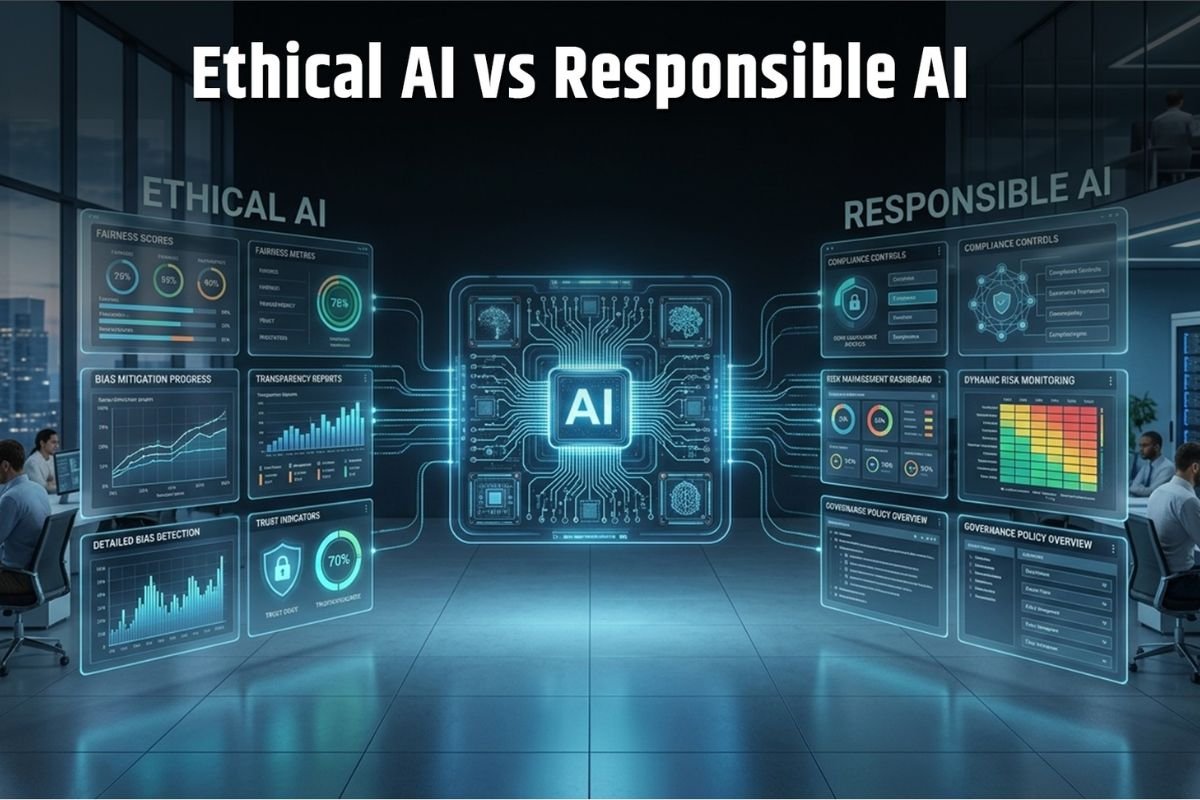
A company deploys an AI tool to screen 10,000 job applications, cutting review time by 70%. Then an audit shows it consistently ranks candidates from certain backgrounds lower. Efficiency gains now come with legal exposure, reputational damage, and lost talent. This is where the debate of Responsible AI vs Ethical AI becomes a business priority. Both aim to reduce harm and build trustworthy systems, yet ethical AI defines the values a system should uphold, while responsible AI turns those values into governance, accountability, and measurable controls.
This guide explains the differences, business implications, practical examples, and the steps organizations can take to implement both.
Table of Contents
Responsible AI vs ethical AI – what is the difference?
Ethical AI sets the moral principles and boundaries for developing and using AI, while responsible AI puts those principles into practice through governance, oversight, and accountability. In short, ethical AI asks whether to use AI. Responsible AI asks how to use it safely and fairly.
What is ethical AI?
Ethical AI is a value-based approach that considers fairness, human rights, privacy, transparency, and human autonomy before an AI system is built or deployed. UNESCO’s framework emphasizes “do no harm,” proportionality, privacy, fairness, and human oversight. It also asks whether an AI application should be developed or used at all. For example, a company may reject an emotion-recognition tool if its potential harm or rights impact outweighs its benefits.
What is responsible AI?
Responsible AI is the practical discipline that applies ethical principles across the AI lifecycle. It includes accountability, risk management, data governance, audits, monitoring, and human oversight.
Organizations must ensure that AI systems remain reliable, secure, fair, and aligned with human rights over time. OECD’s principles link responsible stewardship with accountability, transparency, robustness, safety, and privacy.
Responsible AI vs ethical AI – key differences
| Comparison factor | Ethical AI | Responsible AI |
|---|---|---|
| Primary focus | Moral principles and human values | Practical implementation and governance |
| Central question | Should we use AI this way? | How do we use AI safely and responsibly? |
| Scope | Societal and individual impact | Organizational and operational practices |
| Priorities | Justice, dignity, fairness, and autonomy | Accountability, transparency, safety, and oversight |
| Implementation | Ethical reasoning and value-based decisions | Policies, audits, controls, and monitoring |
| Key stakeholders | Society, ethicists, policymakers, and users | Developers, business leaders, compliance teams, and users |
| Expected outcome | AI aligned with human values | AI systems managed and monitored responsibly |
Where they overlap
The distinction between Responsible AI vs Ethical AI is practical rather than absolute: ethical principles are often embedded within responsible-AI frameworks. Neither approach alone guarantees trustworthy AI. Together, they create AI that is both principled and governed.
How do responsible AI and ethical AI affect business decisions?

Responsible AI and ethical AI affect business decisions by requiring leaders to assess whether an AI system is not only effective, but also fair, safe, transparent, and properly governed. The same system can raise both a moral and an operational question.
The Same AI System Can Raise Two Different Questions
With an AI recruitment system, ethical AI asks whether automated hiring decisions are fair, discriminatory, or harmful to candidates. Responsible AI asks whether the company tests training data, audits outcomes, documents decisions, and provides human review.
The same applies to AI credit scoring or healthcare diagnostics: ethical AI considers whether a decision could unfairly harm people, while responsible AI focuses on validation, data protection, monitoring, and human oversight.
Where business priorities can conflict
The tension in Responsible AI vs Ethical AI appears when priorities collide:
- Efficiency vs fairness: Faster decisions may create unequal outcomes.
- Transparency vs privacy: Explanations must not expose sensitive data.
- Automation vs human oversight: High-impact decisions should not be fully automated.
Responsible AI is not a compliance checklist; businesses must balance competing values and operational priorities.
What happens when businesses ignore responsible or ethical AI?
When businesses ignore responsible or ethical AI, they risk biased decisions, privacy failures, reputational damage, and unclear accountability when harm occurs. These are not abstract risks: they can affect customers, employees, regulators, and the business itself.
Bias and discriminatory outcomes
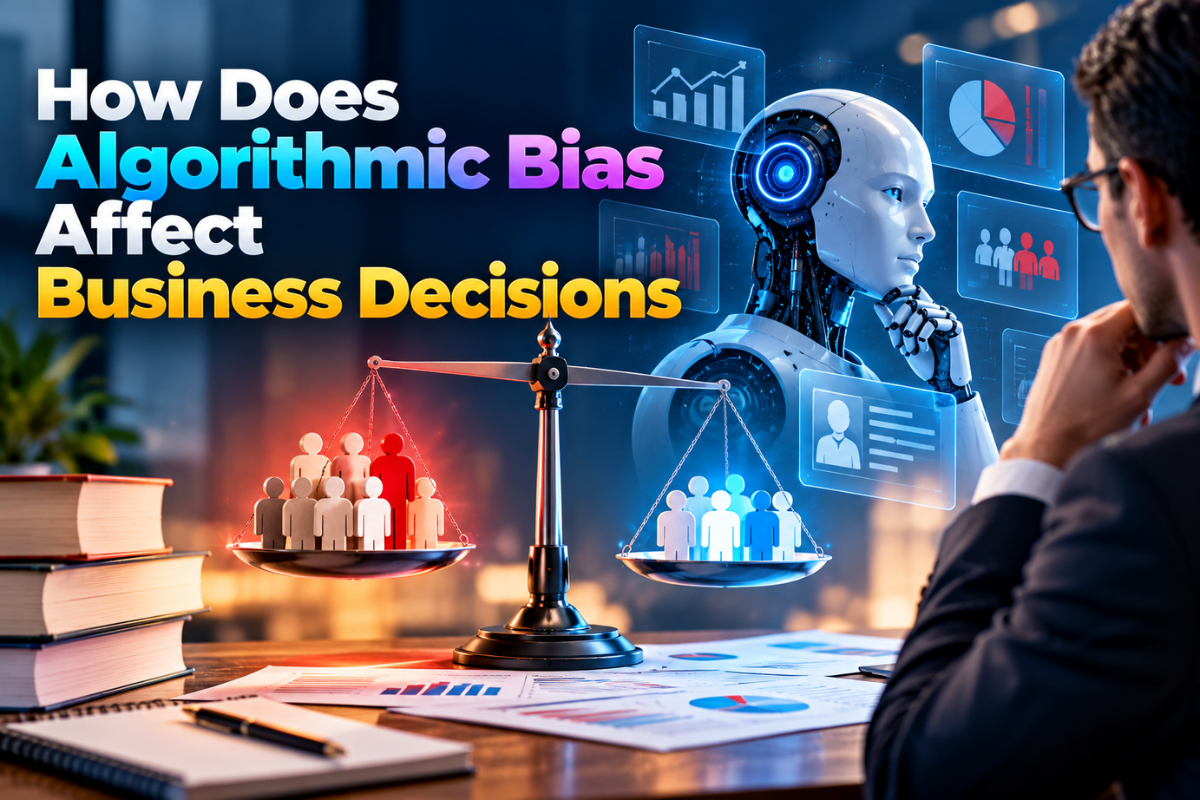
AI trained on historical data can repeat past discrimination in recruitment, lending, and customer profiling. It may also produce unequal error rates across demographic groups, even when overall accuracy appears acceptable. NIST identifies harmful bias and fairness as core AI trustworthiness concerns.
The COMPAS algorithm is a widely discussed example: Harvard notes that seemingly consistent statistical performance can still create unequal consequences across racial groups.
Privacy and security risks
Weak safeguards can lead to unauthorized use of personal information, poor data protection, and exposure of sensitive customer or business data. OECD principles require privacy, security, safety, and bias risks to be managed across the AI lifecycle.
Loss of trust and business accountability
The distinction between Responsible AI and Ethical AI becomes clear when failures occur: an ethical failure violates human values, while an operational failure reflects weak safeguards, monitoring, or accountability. One incident can involve both.
The results include customer distrust, reputational harm, regulatory exposure, and unclear responsibility when AI causes harm.
How can businesses implement responsible and ethical AI together?

Businesses can implement responsible and ethical AI together by pairing clear values with practical controls across the AI lifecycle. NIST frames this through four functions: Govern, Map, Measure, and Manage.
Five-Step Roadmap
1. Set ethical principles first: Define acceptable and unacceptable AI use cases, considering fairness, human rights, privacy, and societal impact. Involve business, technical, legal, and affected-user stakeholders.
2. Assess risks and impacts: Identify risks to customers and employees, and evaluate bias, privacy, security, reliability, and the need for human decision-making.
3. Govern data and transparency: Review data quality and representativeness, document sources and limitations, and apply privacy and security safeguards.
4. Assign accountability and oversight: Define ownership across teams, add human review for high-impact decisions, and create escalation channels.
5. Monitor after deployment: Track fairness and performance, investigate unexpected outcomes, and update safeguards as risks evolve.
Implementation checklist
| Business question | What to verify |
|---|---|
| Is the AI use case appropriate? | Ethical justification |
| Are outcomes fair? | Bias and fairness assessments |
| Is personal data protected? | Privacy and security controls |
| Who owns the decisions? | Accountability structure |
| Can problems be corrected? | Human oversight and monitoring |
The link between Responsible AI vs Ethical AI is governance: ethics defines acceptable use, while assessments, oversight, and monitoring make it enforceable.
Conclusion:
The difference between Responsible AI vs Ethical AI comes down to intent and action. Ethical AI defines what is acceptable, while responsible AI builds the governance, oversight, and monitoring that make those values real. Businesses that rely on only one leave gaps: principles without enforcement, or controls without direction. Pairing both helps organizations reduce bias, protect data, and earn lasting trust.
Start small. Review one AI system your team uses today, ask whether it is fair, and confirm who owns its outcomes. That single check is the first step toward AI that is both principled and accountable.
FAQ:
1. Is responsible AI the same as ethical AI?
No, ethical AI focuses on moral principles, while responsible AI translates those principles into practical policies, governance, and safeguards.
2. What is the biggest difference between responsible AI and ethical AI?
Ethical AI determines what AI should do, while responsible AI focuses on how organizations develop, deploy, and monitor AI systems.
3. Why do businesses need both responsible AI and ethical AI?
Businesses need both to align AI decisions with human values while maintaining accountability, transparency, and effective risk management.