What happens when a competitor changes its pricing, customer demand drops, or a supply chain problem puts deliveries at risk? A business that takes too long to respond may lose customers, revenue, or market share.
The OODA loop offers a structured way to make decisions, act on new information, and adjust as conditions change. Understanding what is the OODA loop in business strategy can help leaders respond to market shifts, improve strategic decision-making, and manage uncertainty without waiting for every detail to become clear.
This article explains the four OODA steps, real-world business applications, the model’s benefits and limitations, and how leaders can use it to make better decisions.
What is the OODA loop in business strategy?
The OODA loop is a decision-making model that helps people and organizations respond to changing conditions through four repeating stages: Observe, Orient, Decide, and Act. It gives teams a structured way to gather information, interpret what it means, choose a response, and learn from the outcome.
U.S. Air Force Colonel John Boyd developed the model through his work on military strategy and fighter pilot decision-making. The concept was later used to explain how people and organizations can make decisions while responding to an active, changing environment.
In business, this loop can help leaders respond to competitor moves, shifts in customer behavior, operational problems, and emerging risks. It works as a continuous feedback loop rather than a one-time decision process.For example, a company may notice that its sales conversion rate is falling. It can examine customer behavior, identify a likely cause, test a change, and then review the results. Those results become new information for the next decision.
The four stages serve different purposes:
| OODA loop stage | Main purpose | Key question |
|---|---|---|
| Observe | Gather relevant information | What is happening? |
| Orient | Interpret the information in context | What does it mean for us? |
| Decide | Select a suitable response | What should we do? |
| Act | Implement the decision and assess the outcome | What happened after we acted? |
This loop begins again when the results of an action provide new information. The aim is not simply to make decisions faster. It is to make informed decisions, act at the right time, and adjust when the facts change.
How do the four steps of the OODA loop work?
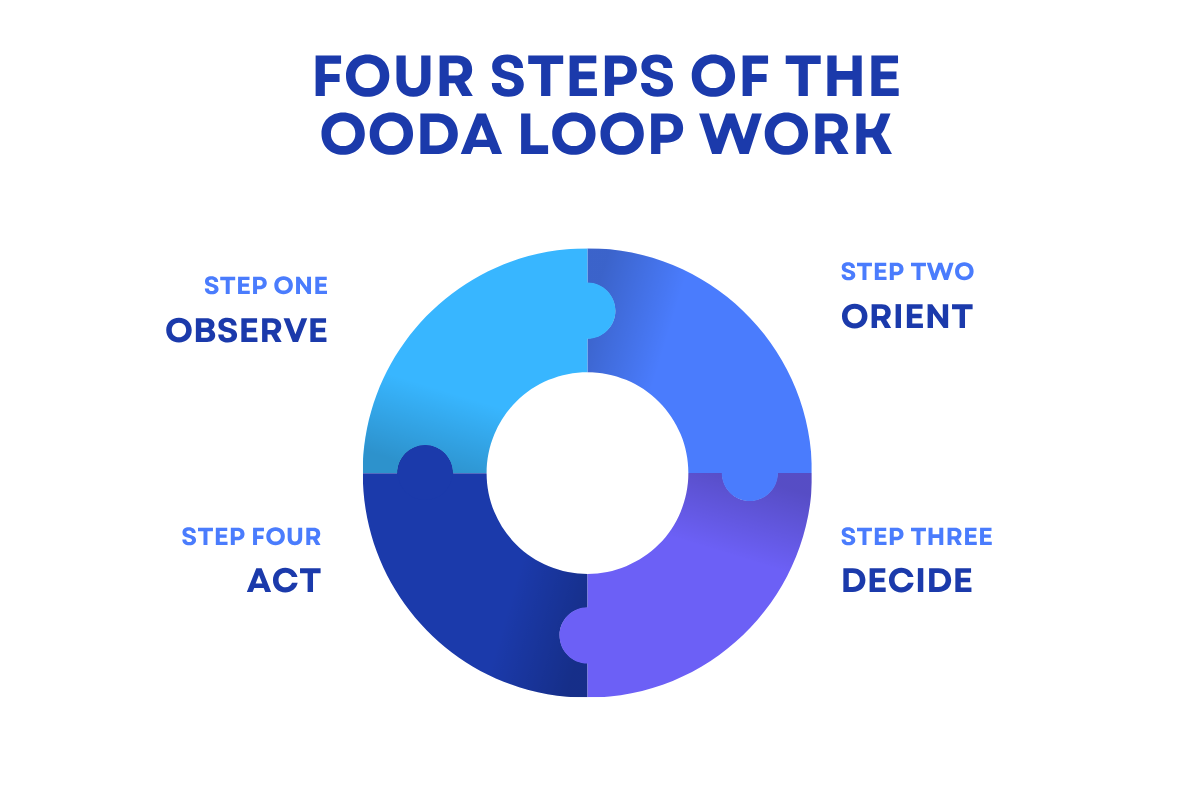
Each step helps a business move from information to action. The quality of the process depends on how well teams gather information, interpret it, assess their options, and learn from the results.
1. Observe
Gather the information you need to understand the problem. Check sales data, customer feedback, website errors, or competitor activity.
For example, if online sales drop, check website traffic, product availability, and checkout errors before changing your marketing budget.
2. Orient
Work out what the information means. Consider your business goals and the possible causes of the problem.
If sales drop because customers face checkout errors, fixing the website may help more than cutting prices. Identify the cause before choosing a response.
3. Decide
Compare your options and choose the best response based on the risks, costs, and expected results.
For example, a marketing team could test a revised checkout page with a small group of users before rolling it out to everyone. Set a clear goal and assign someone to carry out the decision.
4. Act
Put your decision into action and track the results. In the checkout example, monitor completed purchases, checkout errors, and abandoned carts.
If the change improves conversions, consider rolling it out more widely. If it does not, review the results and try another approach. Use what you learn to start the next OODA loop.
How can businesses use the OODA loop to make better decisions?

The OODA loop can support decisions across strategy, marketing, operations, customer experience, and risk management. It is particularly useful when new information may change what a business should do next.
The examples below are illustrative scenarios, not claims about verified company outcomes.
| Business situation | How to apply the OODA loop | Metric to monitor |
|---|---|---|
| Falling sales | Examine customer behavior, identify likely causes, and test a change in pricing or sales messaging | Conversion rate |
| Supply chain delays | Review supplier performance, assess alternatives, and adjust purchasing or delivery plans | On-time delivery rate |
| Rising customer churn | Analyze complaints and cancellation patterns, then test service improvements | Customer retention rate |
| Weak marketing results | Compare channel performance, revise campaign targeting, and measure the response | Cost per acquisition |
| Increasing cybersecurity alerts | Assess the alerts, determine the level of risk, and apply suitable response measures | Time to detect and contain incidents |
Here’s how this loop applies to each area of business.
➢ Competitive strategy
When a competitor cuts prices or launches a new product, businesses can use the OODA loop to assess the impact and choose a response.
A price cut does not always call for lower prices. Customer feedback may show that faster delivery, better service, or improved product features would be more effective.
➢ Marketing and customer experience
If a campaign attracts visitors but few make purchases, the team can review the landing page, offer, and conversion data. It can then test a change and track whether more visitors complete a purchase.
Customer service teams can use the same process to investigate recurring complaints and test ways to improve retention.
➢ Operations and supply chains
When a supplier delay threatens deliveries, managers can review stock levels and supplier updates, assess the impact, and decide whether to adjust orders or find another supplier.
They should then track on-time delivery rates to see whether the response solved the problem.
➢ Cybersecurity and crisis management
Security teams can use the OODA loop to assess alerts, identify threats, and respond under established security procedures. They should then check whether the threat was contained and whether further action is needed.
For security incidents and other high-risk situations, speed must not replace evidence, risk assessment, or required approvals.
What are the benefits and limitations of the OODA loop?
The loop helps businesses respond to change and adjust their decisions. However, its success depends on reliable information, sound judgment, and the ability to act.
➢ Benefits of the OODA loop
- Faster decisions: Gives teams a clear process to assess problems and choose a response.
- Better use of information: Helps leaders update decisions as customer needs, market conditions, or risks change.
- Flexible strategies: Lets teams test actions, review results, and adjust their approach.
- Clearer accountability: Assigning responsibility helps teams act on decisions and measure results.
➢ Limitations of the OODA loop
- Poor data leads to poor decisions: Incomplete or incorrect information can cause teams to misread a situation.
- Rushed action creates risks: Quick decisions can overlook financial, legal, safety, or operational concerns.
- Approval delays slow action: Teams may lack the budget, resources, or authority to respond.
- Complex decisions need deeper analysis: Major investments, acquisitions, and regulatory decisions may require financial models, expert advice, and formal approval.
- Feedback must lead to change: Repeating the loop will not help if leaders ignore results or keep defending ineffective decisions.
How can leaders apply the OODA loop in 2026?

Leaders can use this loop to make decisions, assign responsibility, and measure results. These seven steps help teams act quickly without skipping important checks.
- Define the Decision: Identify the specific problem or opportunity and set a clear goal and deadline.
- Gather Relevant Information: Collect reliable, up-to-date data that helps explain the problem.
- Check Assumptions: Review the evidence, question assumptions, and consider other possible causes.
- Compare Options and Risks: Weigh the costs, benefits, risks, and likely outcomes of each response.
- Take Action: Choose a response, assign responsibility, and set a deadline.
- Measure Results: Track relevant metrics to see whether the action achieved its goal.
- Repeat the Cycle: Use the results to keep, adjust, or stop the action and decide what to do next.
Conclusion:
Understanding what is the OODA loop in business strategy helps leaders make faster, better-informed decisions as markets and customer needs change. ‘
By observing new information, assessing options, acting, and learning from results, teams can respond to challenges without losing sight of business goals. The key is to act with purpose, measure outcomes, and adjust when the evidence calls for a change.
Frequently asked questions
1. What is an example of the OODA loop in business?
A retailer may use it to respond to a sudden change in customer demand or buying habits.
2. How does the OODA loop help businesses gain a competitive advantage?
It helps businesses adapt to market changes and competitor actions before opportunities pass.
3. What is the difference between the OODA loop and PDCA?
OODA focuses on responding to changing conditions, while PDCA focuses on testing and improving processes.
4. When should a business use the OODA loop?
Businesses can use it when conditions change quickly or decisions must be made under uncertainty.