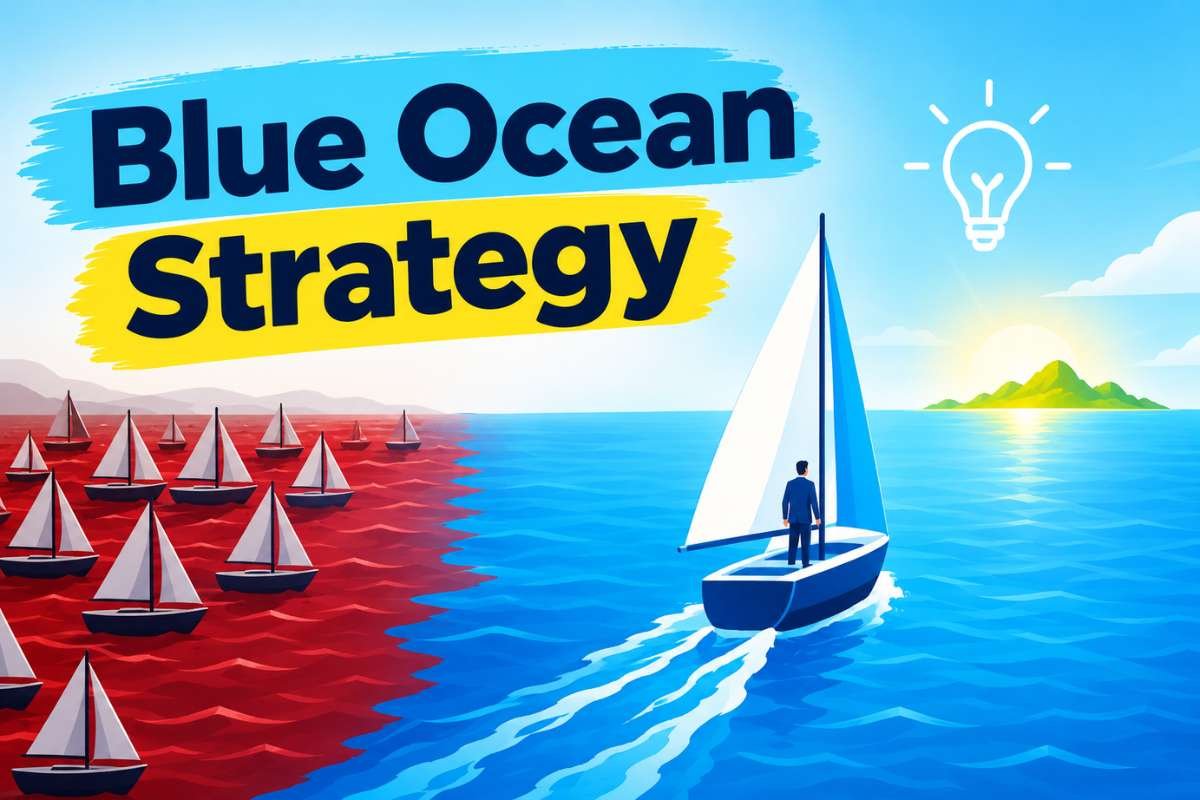
Why do some companies grow fast while rivals fight over every last customer? Often, the winners stopped fighting. They built something new instead.
That idea has a name, and blue ocean strategy tells leaders to leave crowded markets and create fresh demand. Two INSEAD professors introduced it, and smart teams still use it today. This guide covers the core ideas, the tools, real examples, and the limits. Grab your coffee. We’ll keep it plain, practical, and free of buzzwords.
What is blue ocean strategy and where did it start?
W. Chan Kim and Renée Mauborgne created this framework. Both teach strategy at INSEAD, and they co-direct its Blue Ocean Strategy Institute. They introduced the idea in a 2004 Harvard Business Review article and a book followed in 2005.
Picture two oceans. A red ocean holds every industry that exists today. Rivals fight for the same buyers, and the water turns bloody. A blue ocean holds untapped demand. Nobody fights there because nobody has set the rules yet.
The cornerstone is value innovation. You chase differentiation and low cost at the same time. Most companies pick one and accept the trade-off. Blue ocean thinkers refuse to choose.
Why does this matter? For decades, most strategy work focused on beating rivals in known markets. The authors argue that this focus leaves a lot of growth on the table.
How is blue ocean thinking different from red ocean thinking?
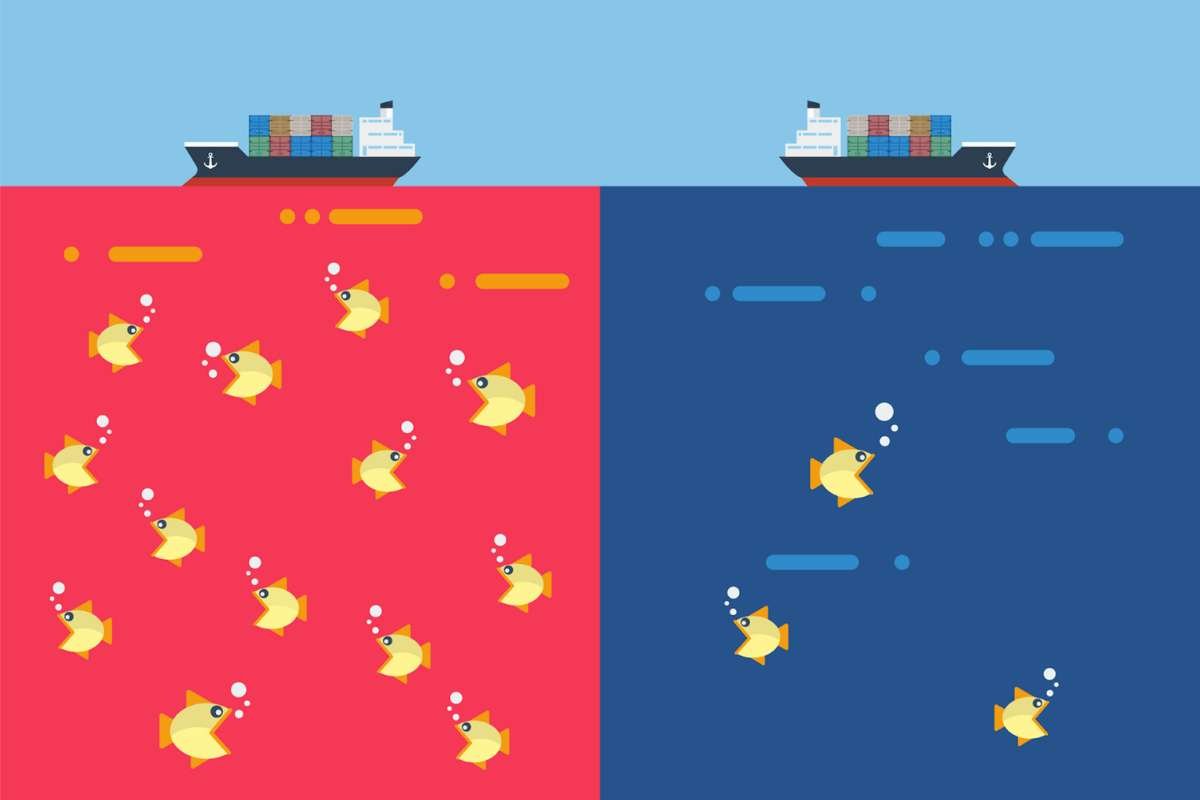
Let me show you the contrast side by side. The shift is growing the market instead of splitting it with rivals.
| Factor | Red Ocean | Blue Ocean |
|---|---|---|
| Market | Existing industry | New, uncontested space |
| Main goal | Beat the competition | Make rivals irrelevant |
| Demand | Fight for current share | Create new demand |
| Cost and value | Pick one | Pursue both together |
Red ocean teams copy each other. Prices fall, and margins shrink. Blue ocean teams ask a different question. They ask what buyers want that nobody offers yet.
You do not need to abandon your current business. Your blue ocean may sit right next to your red one. Check the edges of your industry first.
Does this approach really pay off?
Kim and Mauborgne studied business launches at 108 companies. The results surprised many leaders. Only 14% of launches aimed to create new market space. Yet those launches produced 61% of total profits.
Fewer bets brought far bigger returns. That gap explains why executives who back blue ocean strategy chase bold moves over small tweaks. Incremental launches still bring revenue. They simply bring a smaller slice of the profit.
Think about your next planning meeting. Your team probably spends most of its time on small upgrades. Those upgrades matter, but they rarely change your position in the market.
Risk is real, though. The authors admit that both paths carry risk. A new market can fail just like an old one. The difference is where your upside sits.
Which tools help you find a blue ocean?

Kim and Mauborgne built a toolkit so teams can act. They drew on more than 150 blue ocean creations while building it. Here is the short version.
| Tool | What It Does |
|---|---|
| Strategy canvas | Maps how you and rivals compete today |
| Value curve | Shows where your offer differs from others |
| Four Actions Framework | Guides what to eliminate, reduce, raise, and create |
| Six paths | Helps you spot gaps beyond your current market |
Be honest with your value curve. A curve that mirrors your rivals signals a red ocean, no matter what your team believes. A true blue ocean strategy shows a curve that looks clearly different.
Ready to try it? Follow these steps with your team.
- List the factors your industry competes on, then score your offer and your rivals on each.
- Talk to noncustomers, the people who skip your whole industry, and ask why.
- Ask what you can eliminate, reduce, raise, and create.
- Sketch a new value curve that reflects those answers.
- Test the idea with a small group of real buyers.
Step two often stings. Noncustomers tell you what your industry gets wrong. That feedback points straight at the gaps rivals ignore.
Which companies built a blue ocean?

Cirque du Soleil is the classic case. It blended circus thrills with theater and left old circus costs behind. Southwest Airlines and Starbucks also appear in the authors’ book. Each one gave buyers something rivals did not.
Henry Ford offers an older lesson. He standardized production and cut car prices, which opened a huge new market. Rivals soon arrived, and the blue ocean turned red again. This story matters for your plan. A blue ocean rarely stays empty forever. Winners keep innovating while others copy them.
What are the limits of blue ocean strategy?
Critics make fair points. Some say people spot blue ocean wins only after they happen. Others say the framework feels vague when teams try to apply it. Technology also fails if buyers see no value. Fancy features do not create a blue ocean. Real buyer benefit does.
So plan to defend your space. Rivals copy winners fast. Build a brand, a cost edge, or special know-how early, and you will hold your position longer.
Conclusion
The biggest profit gains came from the few launches that created new markets. Blue ocean strategy turns that finding into a habit you can practice. Try one test this month. Pick a customer group your industry ignores. Call five of them and ask why they skip you. Write down every answer, then sketch a value curve that fixes those gaps. That single exercise will show you whether a blue ocean exists for your product.
FAQs
1. How often should I redraw my strategy canvas?
Redraw it every year, or whenever a rival launches a major new offer.
2. Can a small business find a blue ocean?
Yes. Small teams can study noncustomers and spot unmet needs without a big budget.
3. What is Blue Ocean Shift?
It is the authors’ later book. It offers a more practical process for moving beyond competition.
4. Is blue ocean strategy only for tech companies?
No. Technology alone does not create a blue ocean. Buyer value does, in any industry.
5. Can nonprofits or governments use this framework?
Yes. INSEAD says companies, governments, and nonprofits can all use it to improve performance.