Some managers inspire their teams easily, while others struggle to keep people engaged. The difference is often their leadership style. Leadership shapes how decisions are made, how teams respond, and how goals are achieved.
Today, strong leadership is important for good performance and team engagement. Leaders now carry more responsibility as work becomes more complex across industries.
Understanding leadership styles gives you a clear advantage. It helps you guide teams better, handle pressure, and change your approach when needed instead of using the same method every time.
Here we explain the most common styles, when to use them, and how they affect productivity, decision-making, and motivation, so you can choose the right approach for better results.
What Good Leadership Styles Look Like in Practice?
Leadership style refers to the pattern of behavior a leader uses to guide and motivate people. It includes how leaders communicate, make decisions, and influence team members.
It consists of the methods and behaviors leaders use when directing and motivating their teams. These patterns often develop from personality, experience, and organizational culture.
Organizations depend on defined styles to maintain structure and direction. Without clear leadership approaches, teams lose focus, and productivity declines.
Key Characteristics That Define Leadership Styles
Most leadership behaviors share common elements that shape daily interactions. Below are some characteristics that help leaders maintain consistency across teams and projects.
| Characteristic | Impact on Teams |
| Decision-Making | Controls the speed and accuracy of actions |
| Communication | Shapes clarity and teamwork |
| Motivation | Influences morale and engagement |
| Accountability | Defines responsibility levels |
| Flexibility | Supports adaptation to change |
Top Leadership Styles Every Workplace Uses Today
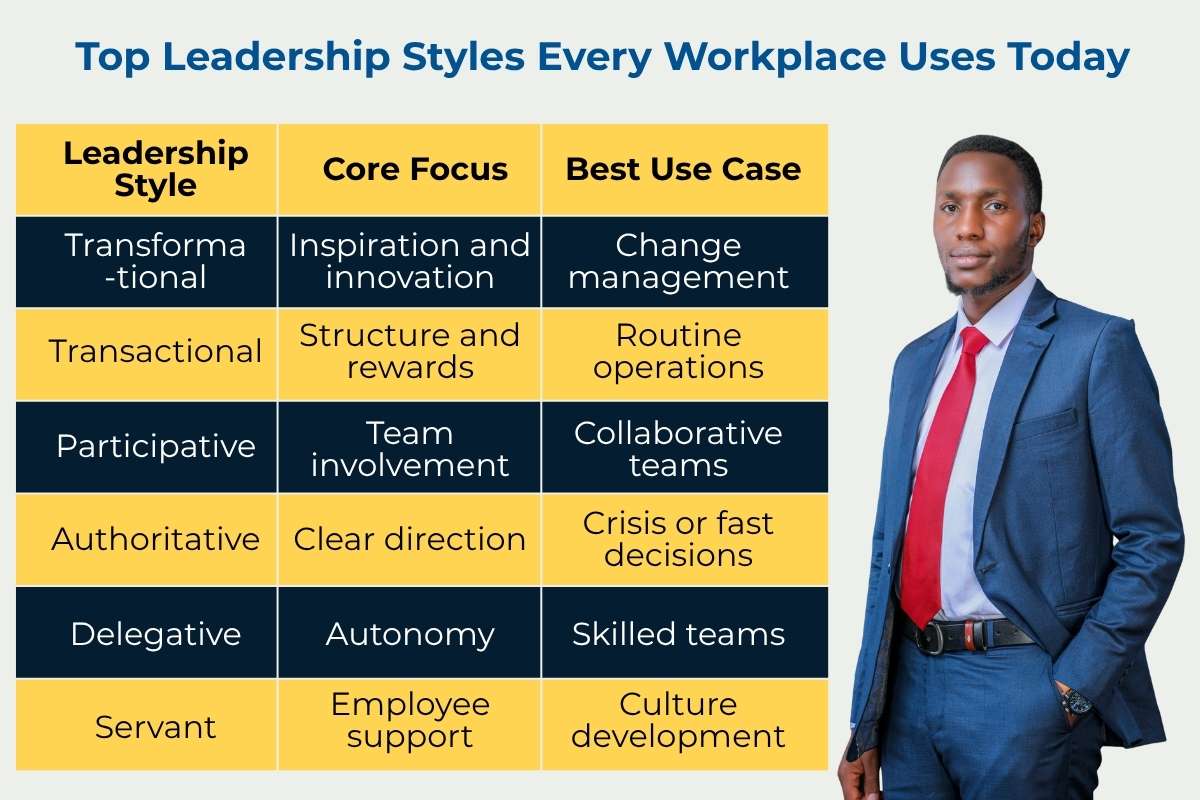
Leadership research shows several styles that appear across industries. Many leaders combine multiple approaches depending on the situation.
According to leadership studies, six major styles dominate modern organizations. Have a quick look at the most common leadership types and their focus.
| Leadership Style | Core Focus | Best Use Case |
| Transformational | Inspiration and innovation | Change management |
| Transactional | Structure and rewards | Routine operations |
| Participative | Team involvement | Collaborative teams |
| Authoritative | Clear direction | Crisis or fast decisions |
| Delegative | Autonomy | Skilled teams |
| Servant | Employee support | Culture development |
Now lets take a closer look at each leadership approach.
Transformational Leadership
Transformational leaders inspire teams to achieve beyond expectations. They focus on vision, motivation, and innovation. These leaders encourage creativity and long-term growth.
Organizations often use transformational leadership during periods of change. Teams rely on strong direction and inspiration to stay aligned.
Transactional Leadership
Transactional leaders focus on structure and rewards. They set clear expectations and monitor results. Performance links directly to rewards or consequences.
This leadership style works well in routine operations. It ensures consistency and predictable outcomes across tasks.
Participative Leadership
Participative leaders involve team members in decision-making. They encourage feedback and collaboration. This approach improves engagement and builds trust.
Teams with experienced members often perform better under participative leadership. Shared decisions create stronger accountability.
Authoritative Leadership
Authoritative leaders provide clear direction and set defined goals. They guide teams while maintaining decision authority.
Authoritative leadership helps organizations make quick decisions and maintain performance under pressure.
Delegative Leadership
Delegative leaders assign responsibility to team members. They trust employees to manage tasks independently.
This style works best with skilled and motivated teams. It increases autonomy and encourages innovation.
Servant Leadership
Servant leaders prioritize employee growth and well-being. They support team members and build a strong workplace culture.
Organizations use this approach to strengthen employee engagement and trust.
READ MORE:
- Visionary Leadership Strategies: Cultivating a Future-Focused Approach
- Characteristics of Transformational Leaders
- Consensus Leadership at Work: When Agreement Helps and When It Hurts
The Everyday Leadership Actions That Improve Performance
Leadership effectiveness depends on behavior, communication, and adaptability. In many workplaces, team results often reflect how clearly leaders communicate expectations and respond to challenges.
Leaders who share clear goals and involve team members in decisions tend to create smoother workflows and stronger accountability. When expectations are understood, teams usually perform with more confidence and fewer delays.
Common leadership behaviors that support better performance include:
- Clear communication reduces confusion and helps teams stay focused on priorities.
- Role clarity helps team members understand responsibilities and avoid repeated mistakes.
- Team involvement encourages ownership and improves accountability.
- Regular feedback allows issues to be addressed before they grow into larger problems.
- Goal alignment keeps teams working toward shared outcomes instead of competing priorities.
Together, these practices show how leadership habits influence daily performance and long-term team success.
Situational Leadership: Choosing the Right Style at the Right Time

Effective leaders adjust their leadership styles based on team needs and work conditions. Situational leadership focuses on flexibility rather than fixed behavior.
Leaders change their approach depending on employee skills, project complexity, and deadlines. Depending on one leadership style reduces effectiveness over time. Balanced leadership improves morale and supports better decision-making.
Different situations often require different leadership responses:
- During a crisis, leaders use an authoritative style to make quick decisions.
- With a new team, coaching helps build confidence and direction.
- For a skilled team, delegative leadership allows independence.
- In creative projects, transformational leadership supports innovation.
- For routine tasks, transactional leadership ensures consistency.
Leaders who adapt quickly manage challenges more effectively and maintain team stability.
Modern Leadership Trends Reshaping Workplaces in 2026
Leadership continues to evolve as organizations adopt digital tools and flexible work environments. Leaders today handle more responsibilities and face growing expectations across teams.
Modern leaders experience increased pressure while managing complex tasks and changing workforce needs. As workplaces shift, leadership skills must evolve to match new demands.
Several leadership trends are shaping the future of organizations, such as;
- Digital Leadership: Leaders now manage remote teams and use virtual communication tools daily. Digital awareness helps maintain clarity across distributed teams and supports faster collaboration.
- Emotional Intelligence Leadership: Emotional intelligence helps leaders understand team concerns and manage conflict. Leaders with strong emotional awareness build trust and improve workplace relationships. Research shows emotional intelligence improves collaboration and team trust.
- Data-Driven Leadership: Modern leaders depend on performance data to guide decisions. Data improves accuracy and reduces guesswork during planning. Organizations that combine data insights with leadership judgment often achieve stronger results.
These trends show that leadership continues to shift toward adaptability and informed decision-making.
How to Identify Your Leadership Style?

Many professionals struggle to define their leadership style. Self-awareness helps leaders recognize strengths and improve performance.
Experts suggest reviewing daily leadership behavior and understanding how teams respond. Observing patterns helps leaders make informed adjustments.
You can identify your leadership style by following simple steps:
- Review how you make important decisions.
- Observe how your team reacts to your instructions.
- Assess how you respond to conflict and feedback.
- Look at the results from recent projects.
- Ask team members for honest feedback.
These steps help leaders recognize habits and refine their leadership approach over time.
The Business Value of Strong Leadership Styles
Leadership style plays a major role in organizational performance. Strong leadership improves communication, engagement, and daily productivity across teams.
Organizations with effective leadership maintain steady workflows and better collaboration between departments. Teams feel more confident when leaders provide clear direction.
When leaders apply the right leadership style, organizations see measurable improvements:
- Improved Decision Quality helps leaders make faster and more accurate choices.
- Stronger Team Engagement increases motivation and cooperation.
- Better Productivity keeps projects moving on schedule.
- Higher Employee Retention builds trust and reduces turnover.
Strong leadership supports long-term stability and business growth.
Conclusion:
Leadership styles shape how teams talk, solve problems, and get work done. Leaders who know different styles can adjust faster and handle challenges with more confidence.
Good leaders do not use just one style. They look at team needs, change their approach, and guide people toward shared goals.
Start using leadership skills in your daily work. Review your habits, try new methods, and improve your leadership style based on results.
FAQs
1. Can one leader use multiple leadership styles?
Yes, effective leaders adjust their style based on team skills, project goals, and organizational conditions.
2. Which leadership style works best for new teams?
Coaching or authoritative leadership works well for new teams because it provides structure and guidance.
3. How do leadership styles affect employee motivation?
It influences morale by shaping communication, recognition, and trust within teams.
4. Can leadership patterns change as careers grow?
Yes, leadership often evolves with experience. As leaders handle new roles and challenges, they naturally refine their approach and adopt new methods.
5. How long does it take to see results after changing a leadership style?
Results can appear within a few weeks if changes are consistent. Team response, communication clarity, and task completion speed are often the first signs of improvement.