
You know how one unclear message can derail an entire project. A missing detail delays a deadline. A vague instruction creates confusion. And a poorly worded email sparks a misunderstanding that takes days to fix.
Strong communication increases performance in every industry. By using social tools to improve communication, companies can increase the productivity of high-skill knowledge workers by up to 25%.
The 7 C’s of communication offer a practical way to do exactly that. Communication experts Scott Cutlip and Allen Center created this framework to help people shape messages that others understand and act on quickly. Leaders use it to guide teams with confidence. Managers rely on it to prevent costly mistakes. Professionals apply it every day to build trust and keep work moving forward.
What Are the 7 C’s of Communication?
The 7 C’s create a structured way to deliver messages that people understand quickly and correctly. Each element strengthens your delivery and reduces the risk of misinterpretation.
The Complete Framework at a Glance
| # | Communication Principle | Core Purpose | Workplace Impact |
| 1 | Clear | Remove confusion | Faster decisions |
| 2 | Concise | Avoid overload | Saves valuable time |
| 3 | Concrete | Use specific facts | Builds credibility |
| 4 | Correct | Ensure accuracy | Prevents costly errors |
| 5 | Coherent | Maintain logical flow | Improves understanding |
| 6 | Complete | Provide full details | Reduces follow-ups |
| 7 | Courteous | Show respect | Strengthens relationships |
How Do the 7 C’s of Communication Work in Real Situations?
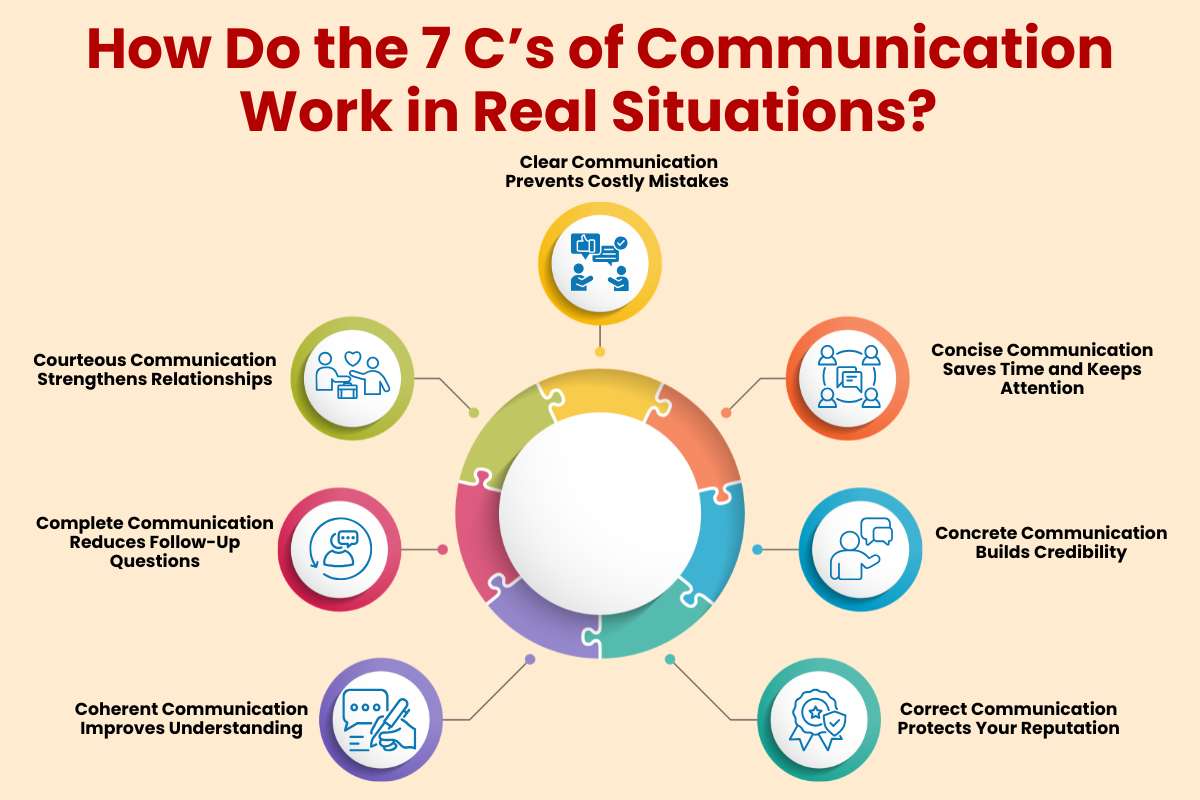
Each of the 7 C’s plays a specific role in how people understand your message. When you apply them together, you reduce confusion, save time, and help teams act faster. Let’s walk through each one with simple examples and real-world impact so you can see how they work in everyday communication.
1. Clear Communication Prevents Costly Mistakes
Clarity sits at the center of effective communication. When people understand exactly what you mean, they act faster and make fewer errors. Clear communication uses simple words and direct sentences. Every message should answer one key question: What action should the reader take?
Poor communication often contributes to project delays and failures. Teams lose momentum when messages lack clear direction.
Example
- Confusing message: Handle the report soon.
- Clear message: Submit the Q3 financial report by 3 PM today using the shared drive.
2. Concise Communication Saves Time and Keeps Attention
People rarely read long messages word by word. Most scan emails and documents quickly. Concise communication removes unnecessary words and focuses only on what matters.
Short messages improve response time. They also make it easier for readers to remember important details.
Example
- Wordy message: I just wanted to reach out to remind you that we might need to review the project sometime soon.
- Concise message: Review the project plan before Friday.
3. Concrete Communication Builds Credibility
Concrete communication relies on facts, numbers, and examples. It avoids vague words like ‘many,’ ‘soon,’ or ‘ a lot.’ Specific details make your message more believable and easier to act on.
Employers value this skill highly. Employers consistently rank communication skills among the most desired workplace competencies.
Example
- Weak statement: Sales improved a lot last month.
- Concrete statement: Sales increased 18% in March compared to February.
4. Correct Communication Protects Your Reputation
Accuracy shapes professional trust. Small mistakes in numbers, names, or grammar can damage credibility. Correct communication means checking facts, reviewing spelling, and confirming technical details before sharing information.
Organizations that focus on writing accuracy often reduce confusion across teams. Tools and structured reviews help prevent avoidable mistakes. This step keeps the 7 C’s of communication working as intended, because even one incorrect detail can weaken the entire message.
Example
- Incorrect message: Send the payment of $15,000 to the vendor today.
- Correct message: Send the payment of $51,000 to the vendor today, as listed in the invoice.
READ MORE:
- Characteristics of Transformational Leaders
- Leading Through Adversity: How Great Leaders Rise in Tough Times
5. Coherent Communication Improves Understanding
Coherent communication organizes ideas in a logical order. Each point connects naturally to the next. Readers should understand the message without jumping back and forth.
Think of coherence as storytelling with structure. Start with context, move to details, and end with action.
Example
- Poor flow: Send the files after the meeting. The client wants updates. We finalized the design yesterday.
- Coherent flow: We finalized the design yesterday. The client requested updates. Send the files after today’s meeting.
6. Complete Communication Reduces Follow-Up Questions
Incomplete messages create delays. Missing details force readers to ask more questions, which slows progress. Complete communication includes all the information someone needs to act without confusion.
A simple rule helps here: answer the Who, What, When, Where, and Why.
Example
- Incomplete message: Send the presentation.
- Complete message: Send the final client presentation to the marketing team by 5 PM today for tomorrow’s review.
7. Courteous Communication Strengthens Relationships
Tone shapes how people respond to your message. Courteous communication shows respect, empathy, and professionalism. Even difficult messages sound more constructive when delivered politely.
Respectful communication is a key factor in a strong workplace culture.
Example
- Harsh message: You missed the deadline again.
- Courteous message: I noticed the deadline was missed. Let’s review what caused the delay and fix it.
Implement the 7 C’s of Communication Starting Today

You can apply the 7 C’s with a few simple habits that improve clarity and reduce delays.
Start with your key action. Place the main request in the first sentence of your email or message. This keeps communication clear and concise, reducing unnecessary follow-ups.
In meetings, open with the purpose and expected outcome. List discussion points in order so ideas stay coherent. End by confirming responsibilities and deadlines to keep communication complete.
Before sending important messages, run a quick check:
Is the action clear, the details correct, and the tone respectful?
Keep this quick reference guide near your workspace. It acts as a final quality control check for high-stakes communication, such as board reports or company-wide announcements.
| Principle | Final Verification |
| Clear | Could a stranger understand the goal of this message? |
| Concise | Can I delete three words without losing the meaning? |
| Concrete | Did I include specific dates, names, or percentages? |
| Correct | Did I double-check the spelling of names and technical stats? |
| Coherent | Does point A lead naturally to point B? |
| Complete | Are all attachments, links, and deadlines included? |
| Courteous | Is the tone professional and free of “passive-aggressive” phrasing? |
Conclusion
Strong communication shapes how work gets done every day. The 7 C’s of communication give you a simple way to share ideas clearly, avoid mistakes, and build trust with your team. When you apply these principles consistently, your messages become easier to understand and act on. Start using the 7 C’s in your daily communication, and you will notice faster decisions, smoother teamwork, and better results.
FAQs
1. Which of the 7 C’s is most important for a leader?
Clarity matters most because it sets the direction for everyone else. If people do not understand the goal, they cannot act on it. Leaders must explain objectives in simple words, so teams know exactly what to do.
2. Can a message be too concise?
Yes, it can. A message that feels too short may leave out important details. Aim to keep your message brief, but include all the information needed to complete the task without confusion.
3. How can I use the 7 C’s when delivering bad news?
Focus on respect and facts. Share accurate information and explain the situation in a logical order. Use a calm tone and clear reasoning so people understand the message and maintain trust.
4. Do the 7 C’s apply to quick messages on Slack or Teams?
Yes, they matter even more in short messages. People receive many updates throughout the day. Clear and concise messages help teams understand priorities without feeling overwhelmed.
5. What is the best way to teach the 7 C’s of communication to my team?
Start by practicing the principles in your own communication. When leaders model clear and respectful messages, teams follow naturally. You can also create simple guidelines that show what strong communication looks like.