A factory can have advanced machines and still lose hours to slow decisions.
When data is spread across different systems, managers may miss downtime, quality issues, and bottlenecks. Industry 4.0 for manufacturers connects machines, people, and data so teams can respond faster.
In simple terms, Industry 4.0 uses technologies like sensors, artificial intelligence, automation, and analytics to improve how factories operate. It helps manufacturers monitor equipment, spot problems, and make better decisions with real-time data.
But what does Industry 4.0 actually mean for a manufacturer?
How does Industry 4.0 for manufacturers work?
Industry 4.0 connects physical production with digital systems. Instead of treating machines, enterprise software, sensors, and workers as separate parts, manufacturers create a connected flow of information across the operation.
McKinsey describes four broad technology groups that support the model. They include connectivity and computing, analytics and artificial intelligence, human-machine interaction, and advanced engineering.
For a manufacturer, the idea becomes easier when you connect each technology to a business problem.
| Technology | What it does | Manufacturing use |
|---|---|---|
| Industrial IoT | Captures machine and process data | Asset monitoring |
| AI and machine learning | Finds patterns and predicts outcomes | Quality and maintenance |
| Digital twins | Models physical systems digitally | Line and plant optimization |
| Robotics | Automates physical work | Assembly and material movement |
| Cloud computing | Connects and processes data at scale | Multi-site operations |
| Edge computing | Processes data close to equipment | Real-time control |
| Advanced analytics | Turns plant data into decisions | Production and quality |
| Additive manufacturing | Builds parts layer by layer | Prototyping and complex parts |
NIST’s 2026 roadmap highlights industrial big data, advanced sensing, autonomous systems, additive manufacturing, digital twins, robotics, logistics optimization, and sustainable manufacturing as major areas for AI and machine learning development.
The lesson for Industry 4.0 for manufacturer planning is simple. You do not need every new technology. You need the right technologies for the problems that limit your plant.
Which Industry 4.0 technologies drive smart factories?
Smart factories rely on connected technologies that collect data, improve decisions, and automate key tasks. Three technologies play a major role in this shift.
1. Connected machines build the data foundation
A smart factory starts with visibility. Sensors can track temperature, vibration, pressure, speed, energy use, and cycle time across production equipment.
Manufacturers can send this data to analytics platforms, manufacturing execution systems, or cloud environments. That gives teams a clearer view of what is happening on the factory floor.
Deloitte found that 57% of surveyed manufacturers use cloud computing at the facility or network level. The same share uses data analytics, while 46% use industrial Internet of Things (IIoT) solutions.
Good data also sets the stage for everything that follows. AI and analytics cannot deliver useful results when the right data is missing or unreliable.
2. AI helps manufacturers act on data
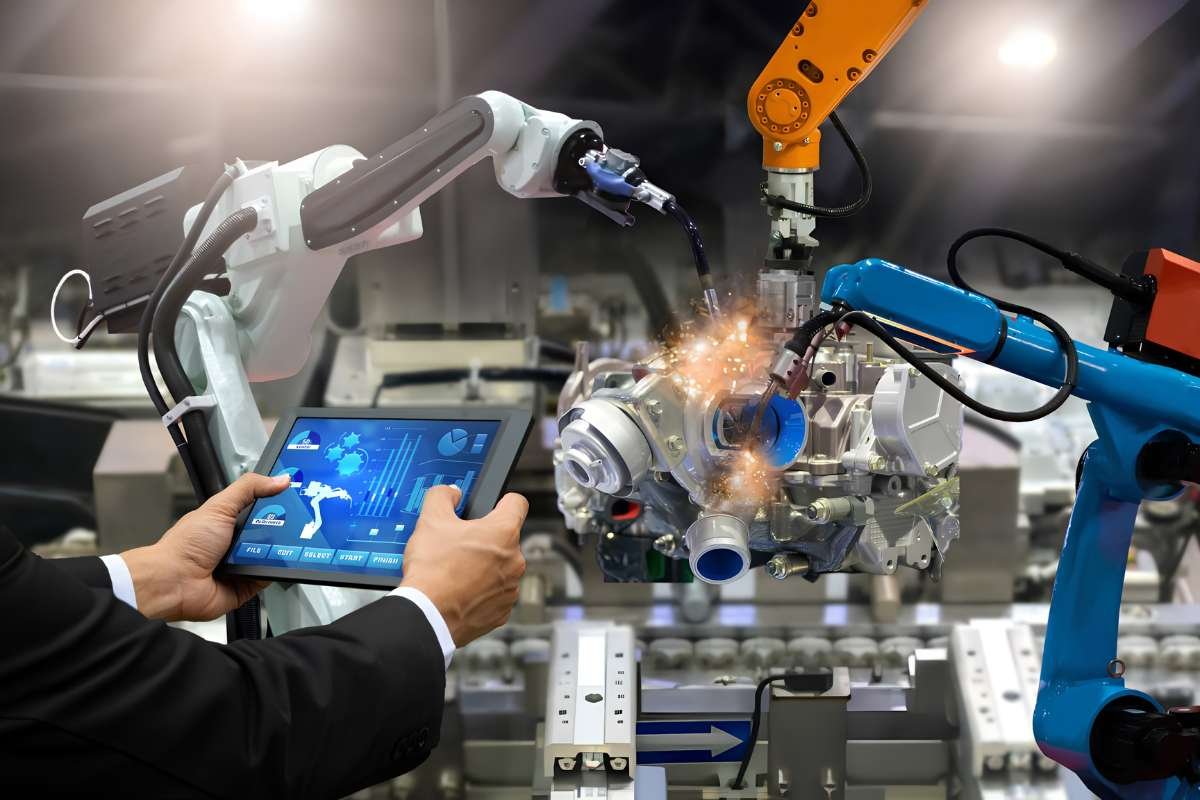
Artificial intelligence can turn factory data into faster decisions. Manufacturers use AI for visual quality checks, demand forecasting, predictive maintenance, process optimization, energy management, and cybersecurity.
Rockwell Automation’s 2026 research found that 34% of manufacturing operations already use AI augmentation. The company expects that figure to reach 54% by 2030.
AI still depends on strong data and reliable systems. Manufacturers also need models that can work with complex industrial data and different sensing and control systems.
3. Digital twins help test changes before they happen
A digital twin creates a digital model of a machine, production line, plant, or process. Teams can use it to test changes before making them on the factory floor.
PepsiCo used AI-powered digital twins at a U.S. Gatorade plant and increased throughput by 20% within three months. PepsiCo also estimates that virtual validation can cut capital expenditure by 10% to 15%.
Manufacturers can use digital twins to test layouts, production changes, capacity plans, and logistics decisions. That can help reduce costly mistakes before physical changes begin.
How does Industry 4.0 for manufacturers improve daily operations?
The strongest programs connect technology to specific operating goals.
1. Predictive maintenance
Instead of waiting for equipment to fail, manufacturers can monitor machine behavior and identify warning signs.
AI models can analyze vibration, temperature, pressure, current, and historical failure patterns. Maintenance teams can then schedule work before a small fault becomes a production shutdown.
That approach can also help plants manage spare parts and maintenance labor more effectively.
2. Smarter quality control
Computer vision and machine learning can inspect products during production. These systems can identify defects faster and create a consistent record of quality results.
NIST’s 2026 roadmap specifically identifies advanced sensing, AI-driven analytics, and manufacturing quality assurance as key areas for future smart manufacturing development.
For Industry 4.0 for manufacturer programs, quality data also helps engineers trace recurring defects back to process conditions.
3. Better production planning
Connected production data gives planners a clearer picture of machine availability, material status, cycle times, and order demand.
Advanced scheduling tools can use that information to adjust production plans faster. Manufacturers can also test alternative schedules before changing the actual production sequence.
Deloitte found advanced production scheduling ranked among the highest-priority manufacturing systems for investment over the next two years.
4. Higher workforce productivity
Automation can handle repetitive tasks while connected systems give workers better information.
That combination can reduce manual data entry, shorten troubleshooting time, and support faster decisions on the shop floor. Yet companies still need skilled workers who understand data, automation, cybersecurity, and industrial systems.
Deloitte found 35% of surveyed manufacturers viewed preparing workers for the factory of the future as a top human-capital concern.
What challenges does Industry 4.0 for manufacturers face?
Technology rarely fails because the software looks weak on a product page. It fails when the factory cannot support the change.
1. Old equipment creates integration gaps: Many plants still rely on legacy machines and control systems. These systems may use different protocols or lack modern connectivity.
Manufacturers often need gateways, edge systems, industrial networks, or new sensors before they can build a reliable data layer.
2. Data quality limits AI: Poor data creates poor decisions.
NIST highlights industrial data complexity and integration with heterogeneous sensing and control systems as major barriers to AI adoption in smart manufacturing.
A company should therefore fix data capture and governance before it pushes advanced AI across the factory.
3. Cybersecurity risk increases: Connected machines create more access points and more data flows.
Deloitte found 68% of surveyed manufacturers had completed a cybersecurity risk or maturity assessment of their smart manufacturing technology stack during the previous year.
Security teams should work with operations teams from the beginning. Network segmentation, identity controls, asset visibility, vulnerability management, and incident response all matter in connected production.
4. Skills shortages slow adoption: A smart factory still needs people who can operate and improve it.
Manufacturers need workers who understand automation, industrial networking, analytics, engineering, and digital systems. Training must therefore become part of the Industry 4.0 roadmap for manufacturers rather than a final project step.
5. Investment can spread too thin: A manufacturer can buy sensors, robots, analytics tools, digital twins, AI platforms, and cloud services without solving its biggest business problems.
A better approach starts with measurable goals. Choose a small number of high-value use cases, prove the result, and then scale what works.
A practical Industry 4.0 roadmap for manufacturers
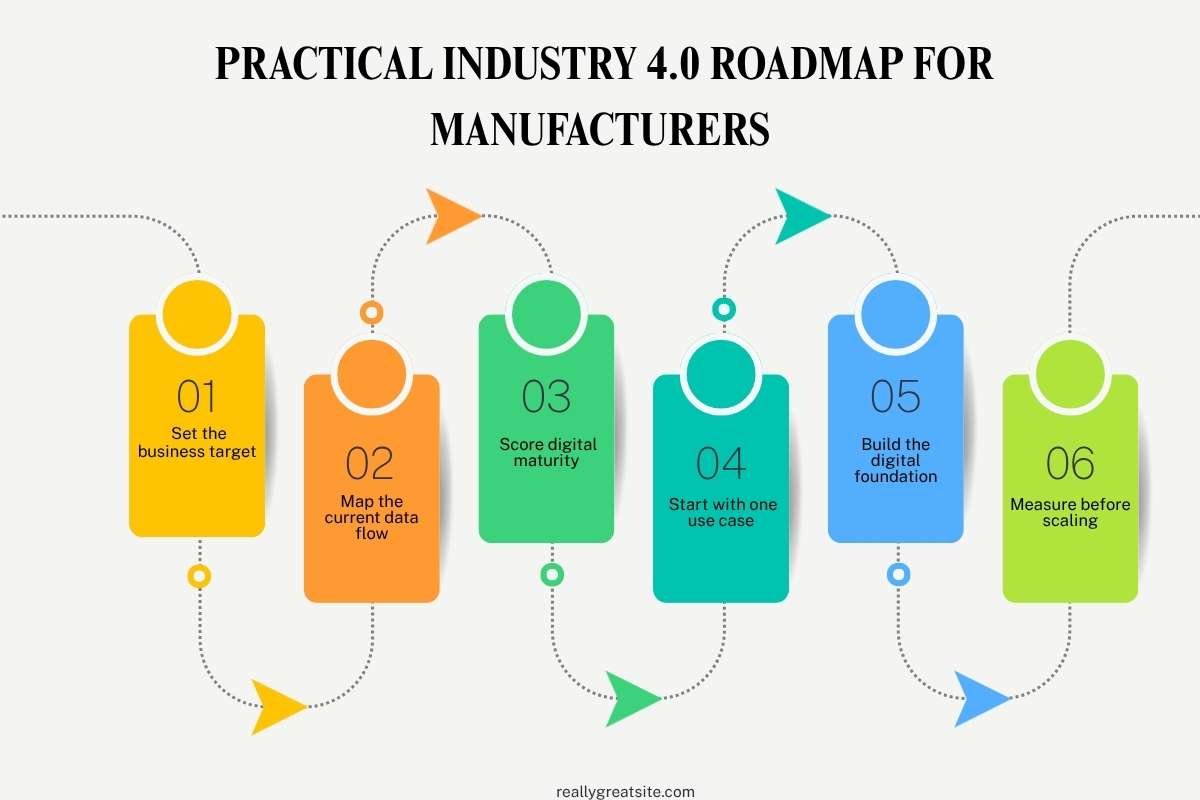
The strongest implementation plans usually follow a clear sequence.
Step 1. Set the business target
Start with a plant problem.
Maybe downtime hurts output. Maybe scrap rates remain high. Maybe planners lack real-time production data. Pick the problem that has a visible financial or operational impact.
Step 2. Map the current data flow
Document where production data comes from and where it goes.
Look at machines, programmable logic controllers, sensors, manufacturing execution systems, enterprise resource planning systems, quality platforms, and analytics tools. This step helps teams spot data gaps and duplicated processes.
Step 3. Score digital maturity
Assess connectivity, data quality, system integration, workforce skills, cybersecurity, and leadership support.
A simple maturity model can help.
| Maturity stage | Factory capability |
|---|---|
| Manual | Paper records and isolated machines |
| Connected | Basic machine and process data |
| Visible | Central dashboards and real-time monitoring |
| Predictive | AI supports maintenance and quality |
| Adaptive | Systems optimize and adjust operations |
Do not rush to stage five. Many plants can generate meaningful value by improving visibility first.
Step 4. Start with one use case
Pick a use case with strong data availability and a clear success metric.
Examples include reducing unplanned downtime, improving first-pass yield, cutting changeover time, or reducing energy use.
Deloitte found 49% of respondents ranked operational benefits as the main value they seek from smart manufacturing, while 44% pointed to financial benefits.
That supports a simple rule. Build the business case around an operating result.
Step 5. Build the digital foundation
Connect the equipment you need. Standardize data. Improve cybersecurity. Create clear ownership for plant and enterprise data.
Do not skip this step to launch an AI pilot faster.
Step 6. Measure before scaling
Track the baseline first.
Then measure production output, downtime, scrap, cycle time, capacity, energy use, or labor productivity after implementation.
Once the result meets the business target, scale the same architecture across another line, plant, or process.
Conclusion
Industry 4.0 for manufacturers works best when technology solves a clear business problem. Connected machines, AI, analytics, digital twins, and robotics can improve visibility, productivity, and decision-making.
Start with one high-value problem, measure the result, and scale what works. Build your digital foundation as you go, rather than trying to adopt every technology at once.
Frequently asked questions
1. Is Industry 4.0 expensive for manufacturers?
Costs vary by factory size, existing systems, and the technologies selected. Manufacturers can control spending by adopting solutions in phases.
2. Does Industry 4.0 require replacing old machines?
No. Sensors, gateways, and integration tools can often connect legacy equipment with newer digital systems.
3. How does Industry 4.0 affect factory workers?
It can reduce repetitive tasks and give workers better access to production information. New roles may also require stronger digital and technical skills.
4. Can Industry 4.0 improve energy efficiency?
Yes. Connected equipment can track energy use and help teams identify waste, unusual consumption, and inefficient processes.
5. How does Industry 4.0 support cybersecurity?
Connected factories need stronger controls for devices, networks, identities, and data. Security should become part of the system design rather than an afterthought.