A profitable business may still face cash flow challenges due to delayed customer payments, excess inventory, and rising operating costs. Working capital optimisation helps businesses manage short-term assets and liabilities, improve liquidity, and maintain smooth daily operations.
In 2026, AI-powered forecasting, automation, and real-time financial data are changing cash management. The Hackett Group’s 2026 survey highlights a $1.94 trillion working capital opportunity among 1,000 large public companies, showing the importance of using available resources more efficiently.
What is working capital optimisation and why does it matter in 2026?

Working capital optimisation is the process of improving how a company manages its current assets and current liabilities to maintain sufficient cash for daily operations.
Working capital is calculated using the following formula:
Working Capital = Current Assets – Current Liabilities
For example, if a company has current assets of ₹50 lakh and current liabilities of ₹30 lakh, its working capital is ₹20 lakh.
However, positive working capital does not automatically indicate financial efficiency. A business may have substantial inventory or unpaid customer invoices but still struggle to meet immediate expenses.
Optimisation helps businesses improve liquidity, reduce borrowing requirements, control operational expenses, and make better investment decisions.
It is particularly important in 2026 because businesses face changing customer payment behaviour, supply chain uncertainty, and rising financing requirements. For Indian companies, Business Standard reported that the net working capital cycle declined to 35.02 days in FY26 from 42.86 days in FY25, based on provisional CMIE data.
What are the key components of working capital optimisation?
Businesses generally focus on three major areas to improve working capital performance.
1. Accounts Receivable: Accounts receivable refers to money customers owe a business for products or services already delivered. Delayed payments can restrict cash availability. Companies can improve collections through timely invoicing, clear credit policies, and regular payment reminders.
2. Accounts Payable: Accounts payable represents money a business owes suppliers and vendors. Companies can manage payment schedules, negotiate suitable credit terms, and automate invoice approvals to maintain liquidity without damaging supplier relationships.
3. Inventory Management: Inventory includes raw materials, work-in-progress products, and finished goods. Excess inventory ties up cash that could support other business activities. Demand forecasting and inventory tracking help companies maintain appropriate stock levels.
Managing these three components together helps businesses maintain a balance between cash availability and operational requirements.
How can businesses improve their cash conversion cycle?

The cash conversion cycle (CCC) measures how long a business takes to convert its investment in inventory and operations into cash received from customers. A shorter cycle generally indicates faster cash recovery.
The formula is:
Cash Conversion Cycle = DIO + DSO − DPO
Where:
- Days Inventory Outstanding (DIO): Time taken to sell inventory.
- Days Sales Outstanding (DSO): Time taken to collect customer payments.
- Days Payable Outstanding (DPO): Time taken to pay suppliers.
For example, if a company has 45 DIO, 30 DSO, and 25 DPO, its cash conversion cycle is 50 days.
Businesses can improve this cycle by:
- Reducing DSO through timely invoicing and regular payment follow-ups.
- Reducing DIO through better demand forecasting and inventory planning.
- Managing DPO through suitable supplier payment terms.
However, companies should avoid delaying supplier payments excessively or reducing inventory to levels that affect customer demand. The objective is to improve cash flow without disrupting operations.
What are the most effective working capital optimisation strategies for 2025-2026?
Finance leaders can use several practical strategies to improve liquidity and reduce financial inefficiencies.
1. Improve Receivables Management: Introduce clear credit policies, monitor overdue invoices, and use automated payment reminders to improve collections.
2. Optimise Inventory Levels: Analyse sales trends and demand forecasts to identify excess stock and avoid unnecessary purchases.
3. Introduce Supply Chain Financing: Businesses can use supply chain financing to help suppliers receive early payments through financial institutions while buyers retain agreed payment periods.
4. Automate Financial Processes: Digital invoice processing, automated reconciliation, and approval workflows can reduce manual errors and processing delays.
5. Strengthen Cash Flow Forecasting: Regular forecasts help companies estimate upcoming receipts, expenses, and funding requirements, allowing finance teams to prepare for potential shortages.
6. Review Supplier Payment Terms: Negotiate payment schedules that support business liquidity while ensuring suppliers receive payments within agreed contractual periods.
These strategies work best when finance, procurement, sales, and supply chain teams coordinate their decisions.
How is AI changing working capital optimisation in 2026?
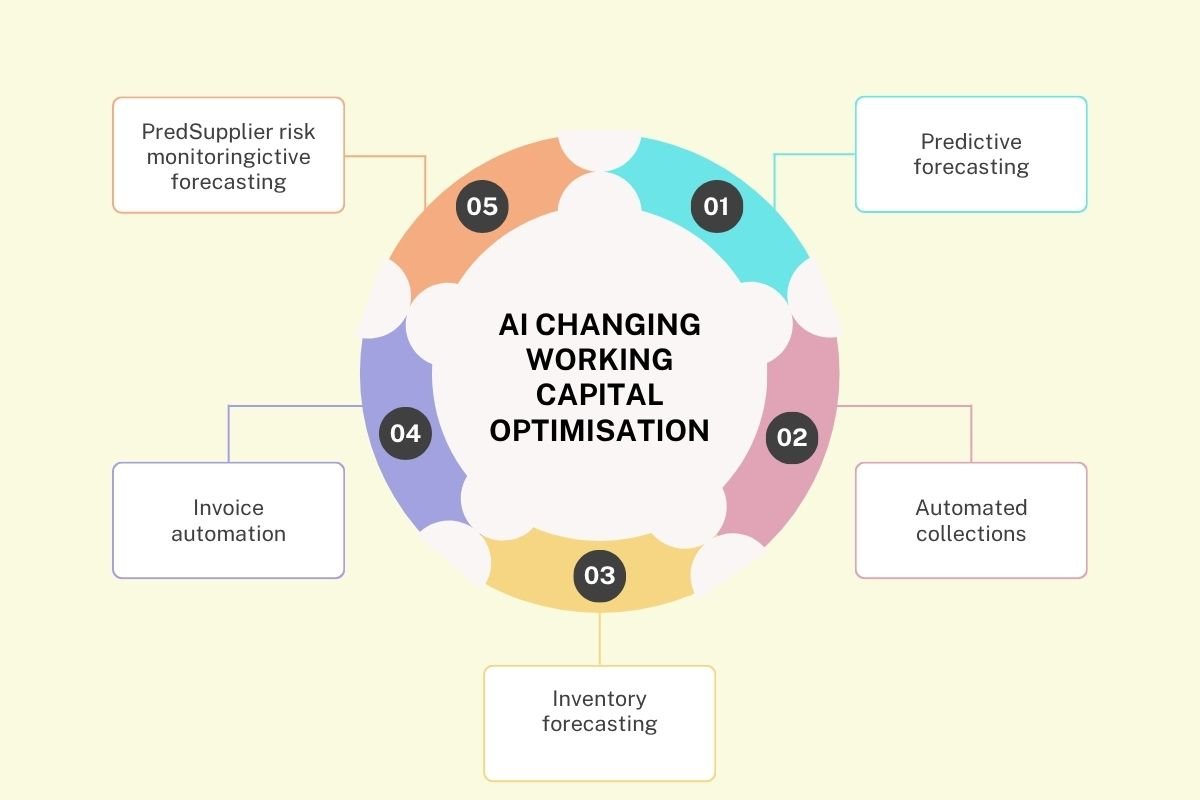
Artificial intelligence is changing how finance teams identify cash flow problems and make operational decisions. Instead of relying entirely on spreadsheets and manual reports, businesses can use AI-powered systems to analyse financial information and identify patterns.
Some important applications include:
- Predictive forecasting: AI analyses historical transactions and customer payment patterns to estimate future cash requirements.
- Automated collections: Intelligent systems identify customers likely to delay payments and help finance teams prioritise follow-ups.
- Inventory forecasting: AI analyses demand fluctuations to recommend suitable stock levels.
- Invoice automation: Automated systems extract invoice details, identify discrepancies, and speed up approvals.
- Supplier risk monitoring: Predictive analytics helps businesses identify potential supplier and payment risks.
Deloitte’s 2025 working capital analysis highlights AI-enabled forecasting, automation, and supply chain finance as important priorities for improving liquidity in 2026.
However, AI cannot replace sound financial planning. Businesses still need accurate data, human oversight, and clear approval processes to make reliable decisions.
What are the biggest working capital challenges finance leaders face?
Even established businesses can experience working capital problems. Some common challenges include:
- Delayed customer payments: Late payments increase outstanding receivables and create cash shortages.
- Excess inventory: Overstocking locks money into products that may take months to sell.
- Unpredictable demand: Changing customer preferences make purchasing and inventory decisions difficult.
- Supplier payment pressure: Short payment deadlines reduce available cash, while excessive extensions can damage supplier relationships.
- Inaccurate forecasting: Poor financial visibility makes it difficult to prepare for upcoming expenses.
These challenges can be particularly difficult for MSMEs with limited access to external financing. A June 2026 report covered by KNN India highlighted that the average invoice payment cycle for the businesses studied had stretched to 73 days.
Companies can address these problems by establishing clear payment policies, improving financial reporting, monitoring cash flow, and maintaining communication with customers and suppliers.
How can finance leaders measure working capital performance?

Measuring working capital performance helps finance leaders identify inefficiencies and track improvements.
Important financial KPIs include:
| KPI | What It Measures |
|---|---|
| Current Ratio | Ability to meet short-term liabilities |
| Quick Ratio | Ability to meet obligations using liquid assets |
| DSO | Average time taken to collect customer payments |
| DIO | Average time inventory remains unsold |
| DPO | Average time taken to pay suppliers |
| CCC | Time required to convert operating investments into cash |
Finance teams should review these indicators regularly and compare results with previous periods and industry benchmarks.
For example, rising DSO may indicate collection problems, while increasing DIO can highlight excess inventory. There is no single ideal working capital target for every business. Industry requirements, business size, and seasonal demand should guide financial decisions.
How can businesses build an effective working capital optimisation plan?
Businesses need a structured approach to improve working capital continuously.
1. Assess the current position: Review current assets, liabilities, outstanding invoices, inventory, and supplier payment schedules.
2. Identify improvement areas: Analyse DSO, DIO, DPO, and CCC to locate operational inefficiencies.
3. Set measurable targets: Establish realistic goals for collections, inventory turnover, and payment management.
4. Adopt technology: Use financial management software, automated reporting, and AI-powered forecasting.
5. Monitor performance: Review financial results regularly and adjust strategies according to changing business requirements.
Coordination across finance, procurement, sales, and supply chain teams is essential to achieving sustainable improvements.
Conclusion
Working capital optimisation helps businesses improve cash flow, manage financial obligations, and reduce unnecessary expenses. Better receivables management, inventory control, and supplier payment planning can strengthen liquidity and support business growth.
In 2026, AI and automation are making financial management more efficient. However, sustainable results depend on accurate data, effective planning, and coordination between finance, procurement, and operations teams.
FAQs
1. What is working capital optimisation?
It is the process of improving current assets and liabilities to strengthen cash flow and business liquidity.
2. What are the four pillars of working capital optimisation?
The four key areas are accounts receivable, accounts payable, inventory management, and cash flow forecasting.
3. How can a company optimise its working capital?
By accelerating customer collections, reducing excess inventory, managing supplier payments, and improving cash flow forecasts.
4. What is a good working capital ratio for a business?
A current ratio of around 1.5 to 2 is often considered healthy, although the ideal level depends on the industry.
5. How does working capital optimisation improve cash flow?
It releases cash tied up in unpaid invoices and excess inventory while improving payment management.