Only 20% of employees worldwide were engaged at work in 2025, according to Gallup’s State of the Global Workplace 2026. Gallup estimates that low employee engagement costs the global economy around $10 trillion in lost productivity.
Employee data can help businesses improve hiring, performance, retention, and workforce planning. HR analytics measures HR process performance, people analytics examines employee outcomes, and workforce analytics focuses on staffing, skills, and future workforce needs. The terms overlap, and their boundaries are not strictly defined.
This article compares people analytics vs HR analytics vs workforce analytics, covering their metrics and tools to help you choose the right approach for your needs.
What is the difference between people analytics vs HR analytics vs workforce analytics?
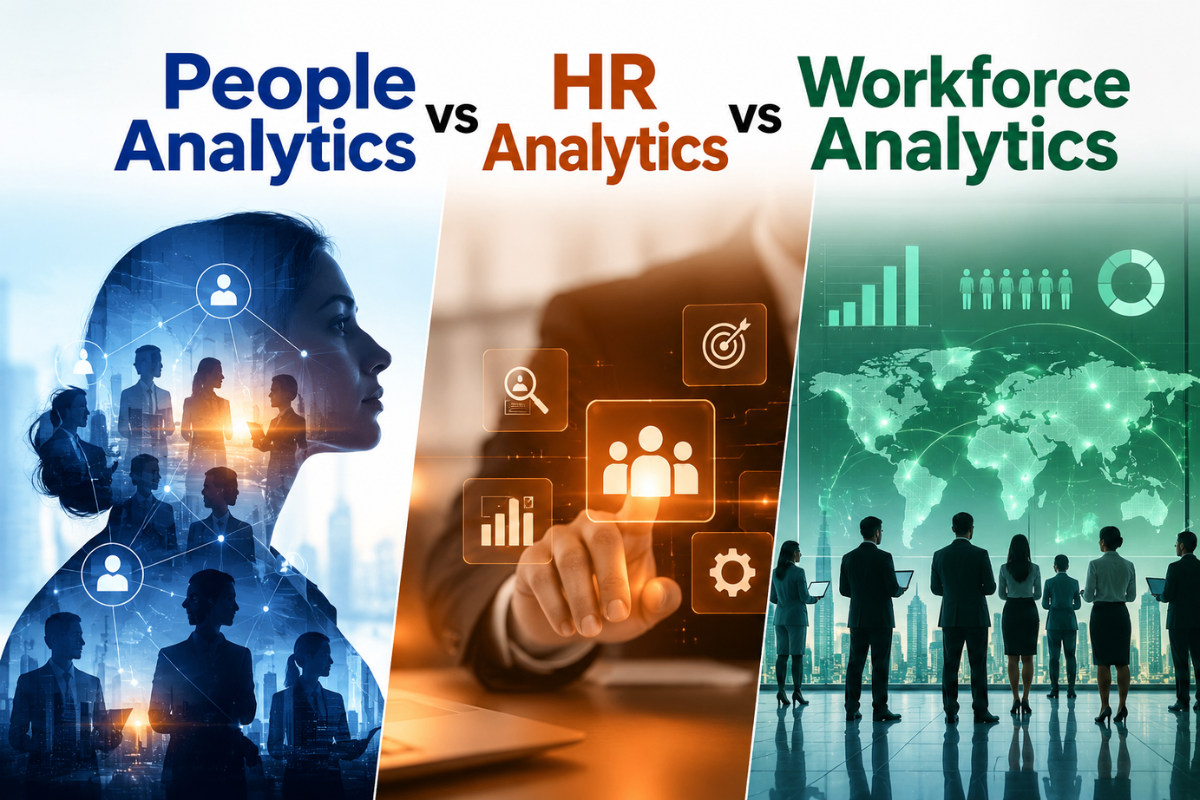
These three terms describe ways to use workforce data to make better business decisions. The main difference is the question being asked and how widely the analysis reaches.
The Chartered Institute of Personnel and Development (CIPD) defines people analytics as the analysis of data about people to solve business problems. It also notes that the practice is sometimes called HR analytics, talent analytics, or workforce analytics.
Here is how each term is commonly used in business.
➢ What is HR analytics?
HR analytics uses data to measure and improve the performance of human resources processes. It helps HR teams understand what is happening across recruitment, payroll, training, attendance, and employee turnover.
For example, an HR team might study time to hire across departments. If some roles take much longer to fill, the data can help identify delays in screening, interviews, or approvals.
Common uses of HR analytics include:
- Measuring recruitment costs and hiring speed.
- Tracking employee turnover and absenteeism.
- Reviewing training completion and performance trends.
- Monitoring HR service quality and compliance reporting.
➢ What is people analytics?

People analytics examines employee data to understand patterns that affect people and business performance. It often connects HR data with information about engagement, management, performance, skills, and employee experience.
For example, a company may find that employees in one department leave at higher rates than employees elsewhere. People analytics can help the business examine potential reasons, such as limited career growth, workload, or management practices.
Common people analytics use cases include:
- Understanding employee engagement and retention.
- Assessing leadership effectiveness.
- Identifying skills gaps and internal mobility patterns.
- Measuring the effects of employee development programs.
➢ What is workforce analytics?
Workforce analytics focuses on the size, structure, cost, capacity, and skills of the workforce. It helps leaders understand whether the business has the people it needs to meet current and future demands.
For example, a company planning to expand into a new market may need more sales staff, service teams, or technical specialists. Workforce analytics can help estimate staffing needs, future labour costs, and possible skills shortages.
Common workforce analytics use cases include:
- Forecasting future headcount and staffing needs.
- Comparing workforce costs with business plans.
- Identifying critical skills gaps.
- Evaluating staffing levels across teams or locations.
- Supporting succession planning and workforce restructuring.
Although these terms often overlap, each puts a different emphasis on workforce data. Here’s a quick comparison of their typical focus, metrics, and business goals.
| Comparison factor | HR analytics | People analytics | Workforce analytics |
|---|---|---|---|
| Main focus | HR processes and efficiency | Employee experience and organizational outcomes | Workforce capacity, skills, and planning |
| Key question | How well are HR processes working? | What affects employee and business outcomes? | Do we have the people and skills we need? |
| Typical data | Recruitment, payroll, absence, training | Engagement, performance, retention, management data | Headcount, skills, labor costs, demand forecasts |
| Typical stakeholders | HR operations and HR leaders | HR leaders, managers, business leaders | HR, finance, operations, workforce planners |
| Common metrics | Time to hire, cost per hire, absence rate | Turnover, engagement, internal mobility | Headcount, vacancy rate, skills coverage |
Which metrics does each analytics approach track?

Each approach tracks different measures based on its main purpose.
HR analytics measures HR process performance.
- Recruitment: Time to fill, cost per hire, recruiter workload
- HR operations: Absence rate, payroll accuracy, training completion
People analytics measures employee outcomes.
- Retention: Voluntary turnover, employee retention by team
- Experience and development: Engagement scores, performance, internal mobility, skills development
Workforce analytics measures staffing capacity and future needs.
- Workforce size: Headcount, vacancy rate, labor costs
- Future readiness: Skills coverage, demand forecasts, revenue per employee
The metrics can overlap. For example, turnover can help HR teams assess retention processes, people teams understand why employees leave, and workforce planners forecast future staffing needs.
People analytics vs HR analytics vs workforce analytics tools
Businesses do not always need a specialist platform to begin. Many start with the HR systems and reporting tools they already use, then add more capabilities when their needs become more complex.
The main tool categories include:
| Tool category | Purpose | Examples |
|---|---|---|
| HRIS and HCM systems | Store and manage employee and HR records | Workday, SAP SuccessFactors, Oracle HCM |
| Engagement and performance tools | Collect employee feedback and performance data | Culture Amp, Lattice |
| Business intelligence tools | Build reports, dashboards, and data visualizations | Tableau, Microsoft Power BI |
| Specialist people analytics platforms | Connect workforce data and support deeper analysis | Visier, ChartHop |
How should businesses choose the right analytics approach in 2026?
Choose the approach based on the business problem, not the name of the analytics function. A small company trying to improve recruitment may need basic HR reporting, while a growing organization may need wider workforce planning and employee analysis.
| Business priority | Best starting point | First step |
|---|---|---|
| Improve hiring efficiency | HR analytics | Review time to hire, cost per hire, and hiring outcomes |
| Understand retention or engagement | People analytics | Compare turnover and employee feedback across relevant groups |
| Plan future staffing and skills | Workforce analytics | Forecast headcount, workforce costs, and skills demand |
| Measure a development program | People analytics | Connect participation with relevant skills or performance outcomes |
| Improve workforce cost planning | Workforce analytics | Compare staffing costs with business forecasts |
Conclusion
The difference between people analytics vs HR analytics vs workforce analytics comes down to the business question you need to answer. HR analytics helps improve HR processes, people analytics examines employee outcomes, and workforce analytics supports staffing and skills planning.
Start with a clear business priority, choose metrics that help measure progress, and use reliable data to inform decisions. As your needs grow, you can combine all three approaches to make better hiring, retention, and workforce planning decisions.
Frequently asked questions
1. Is people analytics the same as HR analytics?
They often refer to the same practice. HR analytics is commonly associated with HR process measures, while people analytics often covers broader employee and business questions.
2. What data does a company need to start people analytics?
Start with relevant data from systems such as recruitment, payroll, performance, training, and employee surveys. The exact data depends on the business question.
3. Can small businesses use people analytics without special software?
Yes. Many small businesses can begin with existing HR systems, spreadsheets, and basic reporting tools before investing in specialist software.
4. How is talent analytics different from workforce analytics?
Talent analytics usually focuses on areas such as recruitment, candidate experience, and talent development. Workforce analytics generally focuses on staffing capacity, skills, costs, and future workforce needs.