Who takes over if your CEO resigns on Monday? Most boards squirm at that question, and few can answer it with confidence.
A leadership gap hits fast. Projects stall, clients get nervous, and your best people start scanning job boards. Every week without a clear successor costs you momentum. A written plan stops that damage before it starts.
This guide explains succession planning steps for enterprises in simple language. You will also get a simple ownership table and the traps that sink even well-funded plans. Let’s get into it.
What are the succession planning steps for enterprises?
Leaders leave more often than boards expect. Russell Reynolds Associates counted 234 CEO departures worldwide in 2025, a 16% jump from 2024. Turnover has reached a record, so waiting no longer works.
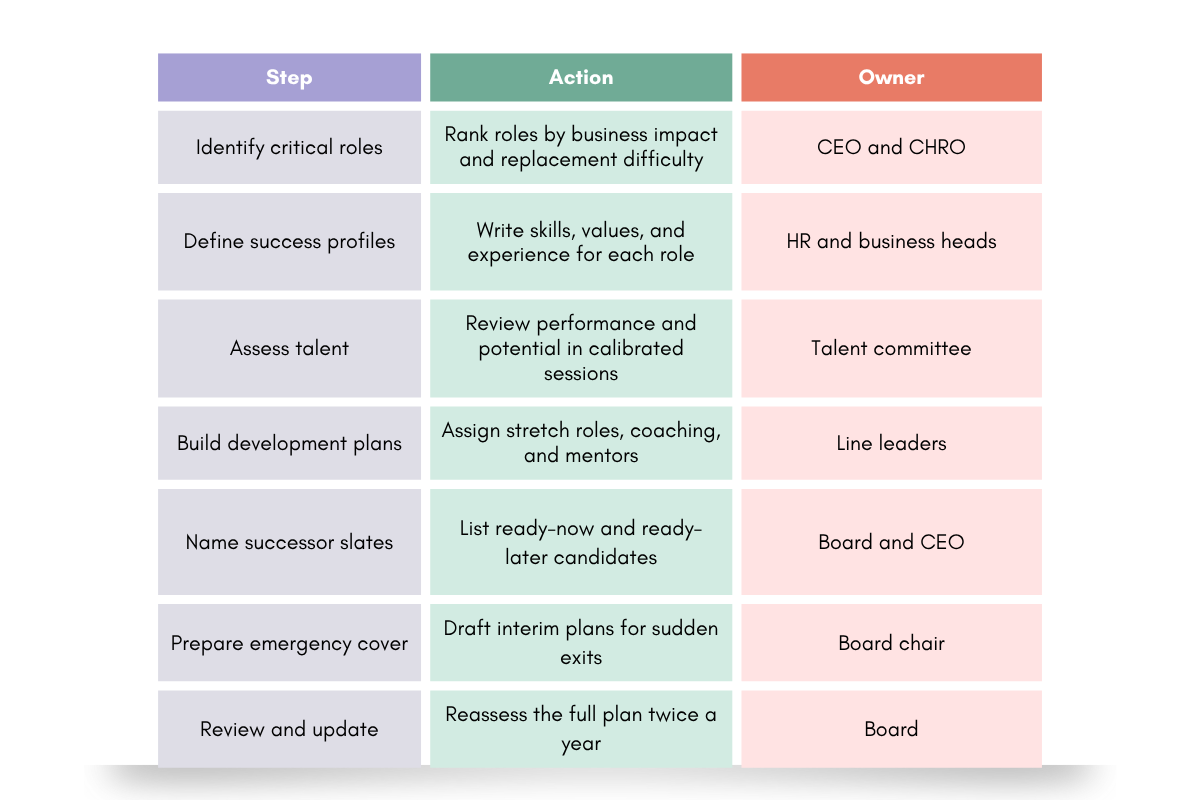
Here is the full sequence at a glance. Each step feeds the next, and each one has a clear owner. These steps work for firms of almost any size.
| Step | Action | Owner |
|---|---|---|
| 1. Identify critical roles | Rank roles by business impact and replacement difficulty | CEO and CHRO |
| 2. Define success profiles | Write skills, values, and experience for each role | HR and business heads |
| 3. Assess talent | Review performance and potential in calibrated sessions | Talent committee |
| 4. Build development plans | Assign stretch roles, coaching, and mentors | Line leaders |
| 5. Name successor slates | List ready-now and ready-later candidates | Board and CEO |
| 6. Prepare emergency cover | Draft interim plans for sudden exits | Board chair |
| 7. Review and update | Reassess the full plan twice a year | Board |
Who should lead the effort? The CEO owns the outcome, and the board oversees it. HR runs the process, while business heads supply the talent insight. When everyone knows their lane, the work moves faster.
Seven steps look simple on paper. The real work sits in the details, so let’s unpack them.
How do you pick critical roles and define success?
Start with a short list. Choose roles whose loss would hurt revenue, compliance, or client trust. Most enterprises begin with the C-suite, then add regional heads and rare technical experts.
Next, write a success profile for each role. Split must-have traits from nice-to-have traits. A leader for a turnaround needs different strengths than a leader for steady growth. Tie every profile to your five-year strategy.
This is where succession planning steps for enterprises differ from small business advice. Scale demands structure, shared language, and agreed criteria across every division. A simple template keeps profiles consistent.
| Profile element | Question to answer |
|---|---|
| Strategy fit | What must this leader deliver over the next five years? |
| Core skills | Which technical and people skills matter most? |
| Values | Which behaviors match your culture? |
| Experience | Which past roles prove readiness? |
| Learnable gaps | Which skills can this person build on the job? |
Watch for one classic trap. Your top sales performer may not become a strong executive. Judge leadership potential, not only past results.
How do you assess and grow your talent bench?

Now you rate your people. Many enterprises use a nine-box grid that plots performance against potential. Calibration sessions keep managers honest, because leaders compare candidates side by side instead of rating them alone.
Add 360-degree feedback for deeper insight. Peers and direct reports often see strengths that bosses miss. They also spot blind spots early, while you can still fix them.
Assessment means nothing without growth. Smart succession planning steps for enterprises treat development as the core, not the paperwork. Try these moves.
- Rotate candidates across regions and functions.
- Give high-potential leaders profit and loss ownership early.
- Pair each candidate with a senior sponsor outside their reporting line.
- Offer board exposure through short, focused presentations.
Build a bench, not a single heir. Name at least two candidates per critical role, and label each as ready now or ready later. A bench protects you when a favorite leaves or stumbles.
Then give candidates honest feedback. A leader who knows the gap can close it. A leader who hears silence starts looking elsewhere.
What happens when a leader leaves without warning?
Even great plans meet surprises. Korn Ferry’s 2025 CEO Succession Study found that 50% of CEO successions in its European sample were unplanned, up from 43% in 2023.
That should worry you. A plan built only for scheduled retirements fails during a sudden exit. Illness, scandal, or a rival offer can remove a leader in days.
Step six solves this problem. Write an emergency playbook before you need it. Smart succession planning steps for enterprises always include an emergency lane. Keep the playbook short, clear, and easy to find.
| Playbook item | What to define |
|---|---|
| Interim leader | Who steps in and for how long |
| Decision rights | Which calls the interim leader can make alone |
| Communication tree | Who tells staff, clients, investors, and regulators |
| Board contacts | Who leads the search and who speaks for the board |
| Knowledge handoff | Where leaders store key contacts and approvals |
Share the playbook with your legal and communications teams. They will need it on the worst day, so let them practice once.
How do you keep the plan working over time?

A plan that sits in a drawer dies quietly. Put succession on the board agenda twice a year. Track a few simple signals instead of drowning in dashboards.
| Signal | What it tells you |
|---|---|
| Bench strength per role | Whether ready candidates exist |
| High-potential retention | Whether your best people stay |
| Time to fill senior roles | How fast you recover from exits |
| Internal promotion rate | Whether development pays off |
Talk to your candidates, too. Some firms hide the list from everyone, and ambitious people leave to find clarity. Honest talks about growth paths keep talent engaged without making promises.
Software helps with tracking, yet people drive results. Treat the tool as a notebook, not a decision-maker. The final item in any list of succession planning steps for enterprises is review, because review keeps every other step alive.
Finally, learn from the common mistakes. Most failed plans trip on the same few errors.
| Common mistake | Better move |
|---|---|
| Picking the best performer by default | Judge potential and fit |
| Naming one heir | Build a bench of two or more |
| Ignoring the plan after approval | Review twice a year |
| Skipping emergency cover | Draft an interim playbook now |
| Keeping candidates in the dark | Share growth paths openly |
Final thoughts
Here is the big takeaway. Succession works when you treat it as a living talent system. Identify roles, define success, grow a bench, prepare for surprises, and review often. Follow these succession planning steps for enterprises, and your next leadership change becomes a handoff instead of a crisis. Pick one critical role this week and draft its success profile. Then book your first talent review. Small starts build resilient companies.
FAQs
1. How early should enterprises start building successors?
Start years before a planned exit. Leaders need time to learn, fail, and grow.
2. Should enterprises hire externally or promote from within?
Do both. Internal candidates know your culture, while outside hires bring fresh skills for big shifts.
3. How is succession planning different from replacement planning?
Replacement planning names a backup for today. Succession planning steps for enterprises grow leaders for future needs.
4. How do family-owned enterprises handle succession differently?
They add ownership, estate, and family governance questions. Involve legal and financial advisors early.