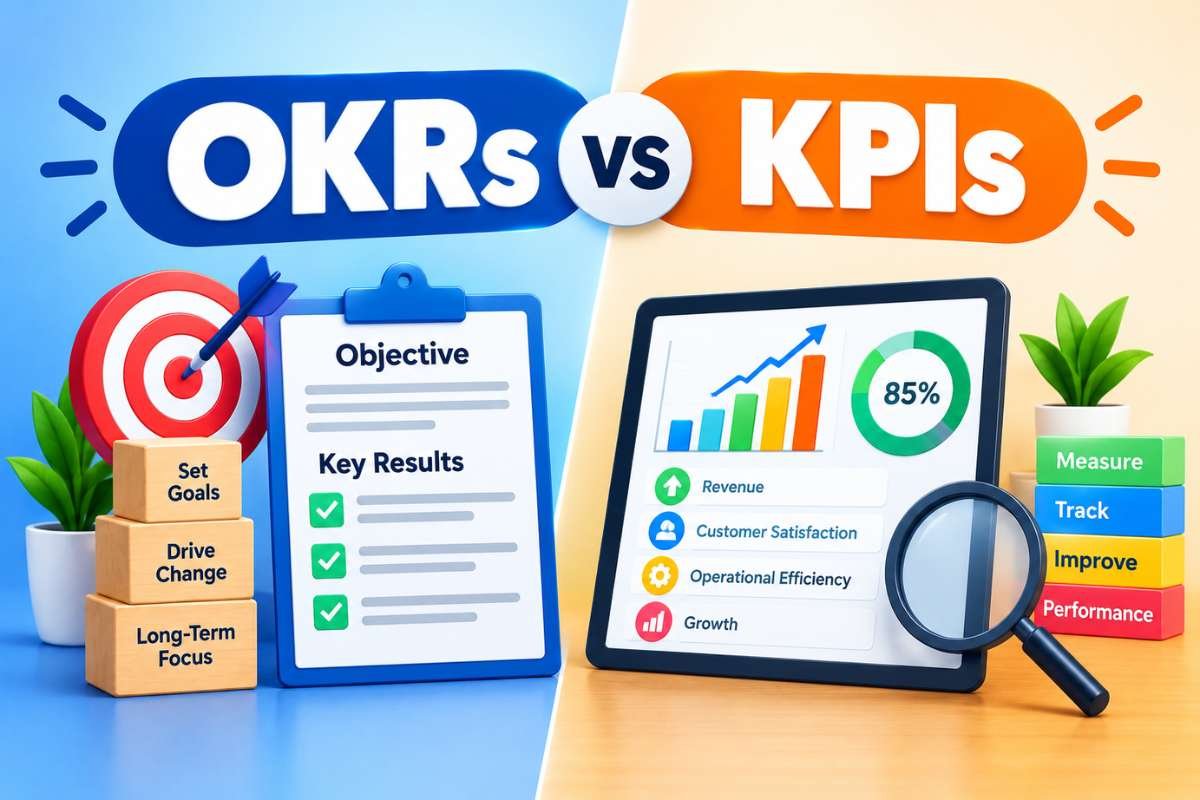
How can you tell whether your business is performing well and moving in the right direction? Revenue, customer retention, and productivity offer useful insights, but you also need clear goals to guide improvement.
Understanding OKRs vs KPIs helps connect these two needs. KPIs show how the business is performing, while OKRs define the results teams want to achieve. Here’s how they differ, when each is useful, and how businesses can use both together.
What are OKRs and KPIs in business?
Understanding OKRs vs KPIs starts with knowing how each framework measures business performance. Both help organizations track results, but they serve different purposes.
➢ What are OKRs?
OKRs stand for Objectives and Key Results. They are a goal-setting framework that connects a clear objective with measurable results.
An objective describes what a team wants to achieve. Key results define the outcomes that will show whether the team has achieved that objective. Effective key results should be specific, measurable, challenging, and focused on outcomes rather than activities.
For example, a company might set the following OKR to improve its customer experience.
Objective: Make the customer experience faster and more reliable.
- Key Result 1: Increase the customer retention rate from 82% to 90% by year-end.
- Key Result 2: Reduce the median customer onboarding time from 10 days to 7 days by the end of Q2.
- Key Result 3: Increase the onboarding completion rate from 65% to 80% by year-end.
These figures are illustrative targets, not reported company results. Each key result defines a measurable outcome and gives the team a clear way to track progress.
OKRs usually run in three-month cycles, but some businesses use longer or shorter periods. Teams check progress regularly and review the results at the end of each cycle.
➢ What are KPIs?

KPIs, or Key Performance Indicators, are measurable indicators of business performance. They help leaders understand whether a business, department, or process is operating as expected.
KPIs can track financial results, customer behavior, operational efficiency, and employee performance. Unlike OKRs, which organize work around selected objectives, KPIs often monitor performance on an ongoing basis.
Common examples include:
- Revenue growth: Measures how revenue changes over a defined period.
- Customer retention rate: Measures the share of customers who continue doing business with a company.
- Customer acquisition cost (CAC): Measures the cost of acquiring a customer.
- Employee turnover rate: Measures how frequently employees leave an organization.
- System uptime: Measures the time a system remains operational and available.
Businesses usually monitor these metrics regularly to identify changes, spot problems, and support decisions. A KPI becomes more useful when leaders define its target, data source, reporting frequency, and the action they should take if performance changes.
What are the key differences between OKRs vs KPIs?
The main difference between OKRs vs KPIs is their purpose. OKRs define the results a business wants to achieve, while KPIs measure how the business is performing. The two frameworks can overlap, but they are not interchangeable.
| Comparison factor | OKRs | KPIs |
|---|---|---|
| Primary purpose | Drive progress toward strategic goals | Monitor ongoing performance |
| Structure | An objective supported by key results | A measurable performance indicator |
| Focus | Change, improvement, and priorities | Business health and operational performance |
| Time frame | Often quarterly or annual | Ongoing, with frequency based on the metric |
| Target | Defines a desired result within a goal cycle | May use a benchmark, threshold, or target |
| Review process | Regular progress reviews and cycle-end assessment | Daily, weekly, monthly, or other scheduled reviews |
| Typical examples | Improve retention, enter a new market, increase product adoption | Retention rate, market share, product adoption rate |
| Best use | Coordinating work around important outcomes | Monitoring results and identifying performance gaps |
The table shows common practices. Businesses can adjust review schedules to fit their needs.
Consider a company with a customer retention rate of 82%. This figure is a KPI because it shows how well the company keeps its customers. If the company aims to raise retention to 90% by year-end, that target becomes a key result under an objective to improve customer retention.
A metric alone does not explain what the business needs to improve. OKRs set the goal, while KPIs track performance and help leaders see whether results are getting better or worse.
When should businesses use OKRs vs KPIs?

Use KPIs to track ongoing performance, OKRs to reach specific goals, and both to improve business results.
➢ When should a business use OKRs?
Use OKRs when a business needs to reach a new goal or make a major change.
Examples include:
- Entering a new market.
- Launching a new product.
- Improving customer retention.
- Increasing product adoption.
For example, a software company can set an objective to grow its active user base. Its key results can measure new user sign-ups, repeat usage, and customer retention.
➢ When should a business use KPIs?
Use KPIs to track how well a business or team is performing.
Examples include:
- Sales: Revenue and conversion rates.
- Finance: Cash flow and profit margins.
- IT: System uptime and response times.
- HR: Employee turnover and retention.
KPIs help leaders spot performance gaps. For example, a rise in customer churn may signal problems with product quality, pricing, or customer support.
➢ When should a business use both?
Use both when a business needs to track current performance and improve results.
For example, an e-commerce company can track its order conversion rate as a KPI. If the rate drops, it can set an OKR to improve checkout completion, with key results focused on reducing cart abandonment and failed payments.
KPIs show where performance stands. OKRs set clear goals for improving it.
How do you connect KPIs to key results?
Turn a KPI into a key result when improving that metric becomes a business priority.
Example:
- KPI: Customer support takes six hours to respond.
- Objective: Improve customer support.
- Key Result: Cut the average response time to under two hours by the end of the quarter.
- Track: Response time, customer satisfaction, and open support requests.
Not every KPI needs to become a key result. Use OKRs for key business goals and KPIs to track ongoing performance.
What mistakes should leaders avoid when using OKRs and KPIs?
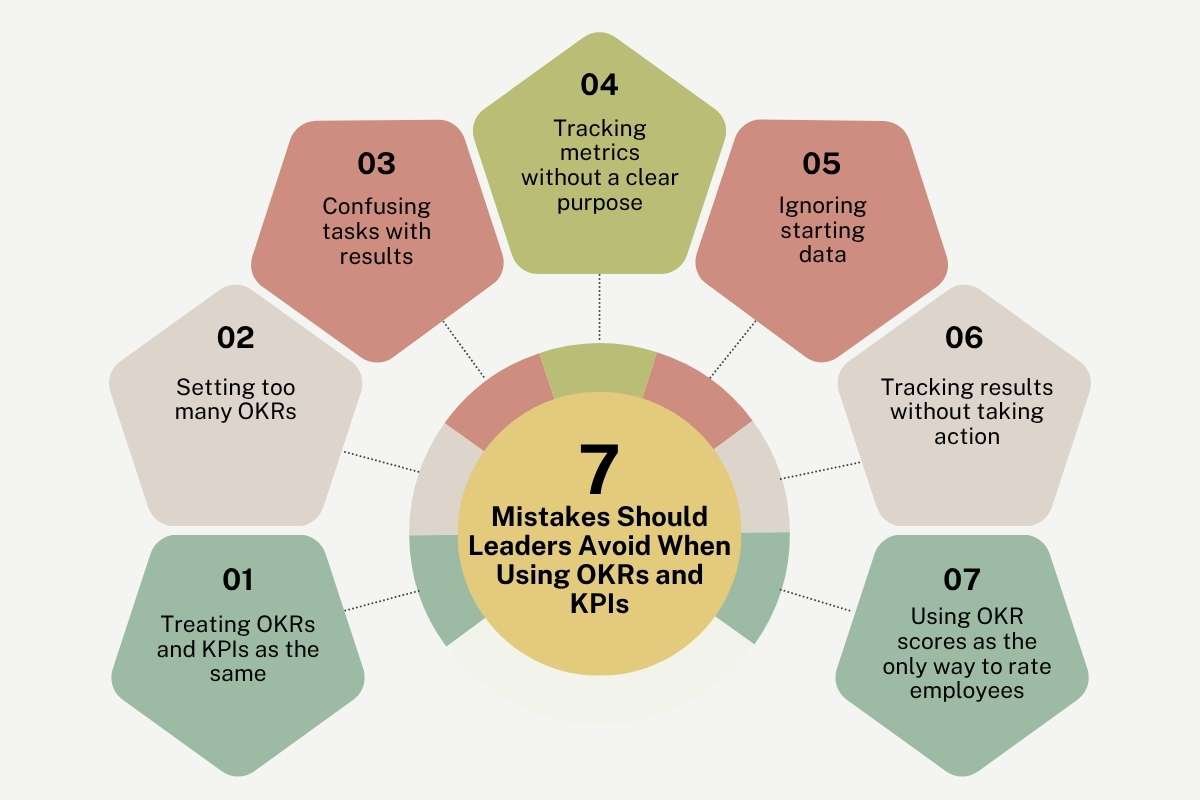
Leaders can weaken their results when they confuse OKRs with KPIs or focus on tasks instead of outcomes. Avoid these common mistakes:
- Treating OKRs and KPIs as the same. KPIs track performance, while OKRs set goals and measure progress.
- Setting too many OKRs. Too many goals can spread teams too thin and reduce focus.
- Confusing tasks with results. Launching a campaign is a task. Increasing qualified leads by a set amount is a measurable result.
- Tracking metrics without a clear purpose. Every KPI should help leaders track results or make better decisions.
- Ignoring starting data. Teams need to know their current results before they set targets.
- Tracking results without taking action. Leaders must address problems and adjust plans when progress falls short.
- Using OKR scores as the only way to rate employees. This can lead teams to focus on targets instead of teamwork, long-term results, and honest reporting.
How can you choose the right framework in 2026?
Choosing between OKRs vs KPIs depends on your business goals. Follow these steps:
- Define the goal. Decide whether you need to track performance or improve results.
- Check current performance. Use existing data to set a clear starting point.
- Choose the framework. Use KPIs to track performance, OKRs to drive change, or both to do both.
- Assign ownership. Give each goal and metric a clear owner.
- Review progress. Track KPIs regularly and review OKRs during each goal cycle.
- Take action. Fix problems and adjust plans when results fall short.
Review your metrics as business goals change. Keep useful KPIs and update OKRs when priorities shift.
OKRs set goals for change, while KPIs track performance. Using both helps leaders measure results and stay focused on key business goals.
Conclusion
Understanding OKRs vs KPIs helps businesses set clear goals and track performance. OKRs guide teams toward key business goals, while KPIs show how well the business is doing. Using both helps leaders track progress, fix problems, and make better decisions.
Frequently asked questions
1. How many OKRs should a company set at one time?
Most teams should focus on a small number of OKRs, often two to five objectives per cycle, to keep their work focused.
2. Who should be responsible for setting OKRs and KPIs?
Leaders should set company goals, while team managers and employees help define relevant targets and measures.
3. How do you measure the success of an OKR?
Measure success by checking whether the key results meet their targets and support the main objective.
4. What tools can businesses use to track OKRs and KPIs?
Businesses can use spreadsheets, project management tools, or performance dashboards to set targets and track results.
5. How can OKRs vs KPIs support employee accountability?
OKRs clarify the results teams need to achieve, while KPIs help them track performance and spot areas that need improvement.